Exploring the Intricacies of Solar Cell Structure
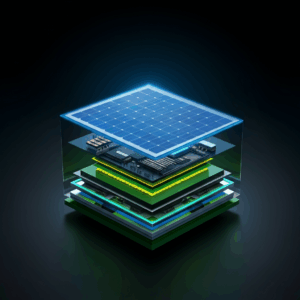
Solar technology is now one of the most significant inventions of the twenty-first century due to the global transition to renewable energy. The solar cell, often known as a photovoltaic (PV) cell, is the central component of solar technology. The effectiveness of a solar cell, which uses the photovoltaic effect to directly convert sunlight into electricity, is mostly determined by its internal structure.
Students, researchers, engineers, and businesses involved in renewable energy must comprehend the structure of solar cells. In addition to examining their practical uses, this article will offer a thorough overview of the design, layers, principles, materials, and developments in solar cell architectures.
What is the structure of a solar cell?
The physical configuration of layers and materials that cooperate to absorb sunlight and transform it into electrical energy is known as a solar cell structure. Even though there are many different kinds of solar cells nowadays, including thin-film, polycrystalline, monocrystalline, and cutting-edge technologies like perovskite, the basic structure is still the same.
Multiple layers of conductors, semiconductor materials, and protective coatings make up a typical solar cell. These layers are meticulously designed to optimise solar absorption, reduce energy loss, and guarantee longevity in a range of environmental circumstances.
Fundamental Elements of the Structure of a Solar Cell
1. Layer of Front Contact
The topmost layer of a solar cell that both carries the generated current and lets sunlight in is called the front contact layer. Usually composed of a transparent conductive oxide (TCO), such as indium tin oxide (ITO), it offers superior light transmission together with strong electrical conductivity. This layer permits electrons to move freely throughout the structure while guaranteeing that photons from the sun can pass through the surface unhindered. The efficiency of the solar cell is directly increased by a well-designed front contact, which reduces resistance and stops needless sunlight loss.
2. ARC, or anti-reflective coating
Without an anti-reflective coating, a large percentage of incoming sunlight would be reflected by a solar cell, thus decreasing its efficiency. Manufacturers use a thin ARC coating composed of silicon nitride (Si3N4) or titanium dioxide (TiO2) to get around this. By minimising surface reflection, this layer makes sure that the semiconductor receives the most light possible. The anti-reflective coating is an essential part of the solar cell construction since it not only improves light absorption but also helps to maintain constant efficiency in a variety of lighting scenarios.
3. The Layer of Glass
The glass layer serves as the solar cell’s barrier, protecting it from the elements, including wind, rain, dust, and mechanical impact. Tempered glass, which offers strength and durability while letting sunlight through with little absorption loss, is typically used to make it. Anti-soiling or hydrophobic coatings are frequently applied to modern glass layers to enhance light penetration and stop dirt buildup. In order to maintain high energy production and prolong the life of solar cells, the glass layer provides environmental protection and structural support.
4. Layers of Semiconductors
The semiconductor layers, which are mostly in charge of turning sunlight into electricity, are at the core of the solar cell construction. Because of its efficiency and quantity, silicon is the most often used semiconductor material. The semiconductor is separated into two layers: the p-type layer, which has holes or positive charge carriers, and the n-type layer, which is rich in electrons. Electrons are excited, and electron-hole pairs are formed when sunlight strikes the semiconductor. An electric current is produced as these pairs travel through the layers. The solar cell’s efficiency is directly influenced by the thickness, purity, and arrangement of these semiconductor layers.
5. The p-n junction
The contact between the p-type and n-type semiconductor layers creates the p-n junction, which is the solar cell’s main working area. It ensures that the charges are segregated and guided in a single direction by producing an electric field that pushes electrons toward the n-side and holes toward the p-side. This permits the current to flow as electricity and stops electron-hole pairs from recombining. In the solar cell, the p-n junction essentially functions as a diode, directing the flow of charges to generate a useful electrical output.
6. Layer of Back Contact
Completing the electrical circuit and reflecting unused sunlight into the semiconductor for another opportunity at absorption are the two main tasks of the rear contact layer, which is located at the bottom of the solar cell. Typically, it is composed of conductive metals with low resistance and great reflectivity, such as silver or aluminium. The back contact improves the solar cell’s performance by limiting energy loss and guaranteeing an efficient flow of electrons. Without it, the circuit wouldn’t be complete, and sunlight couldn’t be converted into electrical energy that could be used.
7. Layer of Encapsulation
All of the solar cell’s components are held together by the encapsulation layer, which also shields them from external factors like moisture, UV rays, and heat stress. Because they offer flexibility, transparency, and insulation, materials like ethylene-vinyl acetate (EVA) are frequently utilised for encapsulation. Additionally, this layer protects fragile semiconductor layers and circuits from mechanical stress. The encapsulating layer helps prolong the life of solar modules and guarantees steady performance over decades of operation by preserving stability and durability.
What are the Solar Cell Structure Types?
1. Structure of Monocrystalline Solar Cells
The monocrystalline solar cell structure has a consistent dark black appearance since it is composed of a single, continuous silicon crystal. Since electrons can move more freely due to the homogeneous crystal lattice, which lowers resistance, this configuration has a high efficiency, usually between 18% and 22%.
In addition to being space-efficient, monocrystalline cells provide more electricity per square meter than other varieties. However, because it necessitates cutting wafers from pure silicon ingots, its production process is intricate and expensive. Monocrystalline cells are a common option for commercial installations and residential rooftops when performance and efficiency are crucial, despite their greater cost.
2. Structure of Polycrystalline Solar Cells
The surface of the polycrystalline solar cell has a characteristic blue, speckled appearance because it is composed of many silicon crystals that have been fused. These cells are among the most popular kinds in the solar industry since they are simpler and less expensive to produce than monocrystalline cells. Multiple crystal boundaries, on the other hand, result in slightly lower efficiency in the 15%–17% range because electrons encounter greater resistance as they travel. Despite this, polycrystalline solar cells are a dependable option for both large-scale solar farms and installations with a tight budget because they provide a fair balance between price and performance.
3. Structure of Thin-Film Solar Cells
Very thin layers of semiconductor materials, such as amorphous silicon, cadmium telluride (CdTe), or copper indium gallium selenide (CIGS), are used in the thin-film solar cell structure. These cells are perfect for applications that need mobility, such as portable devices, building-integrated photovoltaics (BIPV), or curved surfaces, because they are lightweight, flexible, and simpler to manufacture. Although thin-film cells are less efficient than crystalline silicon cells, they typically between 10% and 12%. They are nonetheless appealing in some applications due to their versatility and cheaper manufacturing costs. An additional benefit of thin-film architectures is their superior performance over crystalline cells in hot or low light.
4. Structure of Perovskite Solar Cells
The construction of the perovskite solar cell is based on perovskite-structured materials, which have attracted a lot of interest lately in solar research because of their impressive efficiency gains. In lab settings, perovskite cells can achieve efficiencies of more than 25% and are lightweight and cheap to produce. Compared to conventional silicon, the structure is easy to produce and frequently uses solution-based techniques, which lower production costs. But issues like long-term stability, moisture sensitivity, and production scalability are still being worked out. Perovskite solar cells have the potential to transform the solar business by fusing affordability with high efficiency if these problems are fixed.
5. Structure of Multi-Junction Solar Cells
A sophisticated design, the multi-junction solar cell structure stacks several semiconductor layers that are each adjusted to absorb distinct sunshine wavelengths. Multi-junction cells, the most efficient solar technology on the market, generate much greater efficiencies are often above 40%, by absorbing more of the sunlight spectrum. These cells usually combine elements such as silicon, gallium arsenide (GaAs), and indium phosphide (InP). Multi-junction solar cells are mostly utilised in specialist applications like satellites, space missions, and concentrated solar power systems because of their high cost and intricate production process. They are an essential component of state-of-the-art solar technology because of their unparalleled efficiency.
Conclusion
The efficiency with which sunlight can be transformed into energy is largely determined by the construction of the solar cell. Every layer from the semiconductor core to the glass cover contributes to cost-effectiveness, performance, and durability. Solar cells are a key component of the global adoption of renewable energy since they are growing more effective, adaptable, and reasonably priced as a result of ongoing research and technological developments.
Knowing the structure of solar cells is crucial for engineers, scientists, businesses, and governments looking to hasten the green energy revolution as the globe shifts to sustainable energy sources.