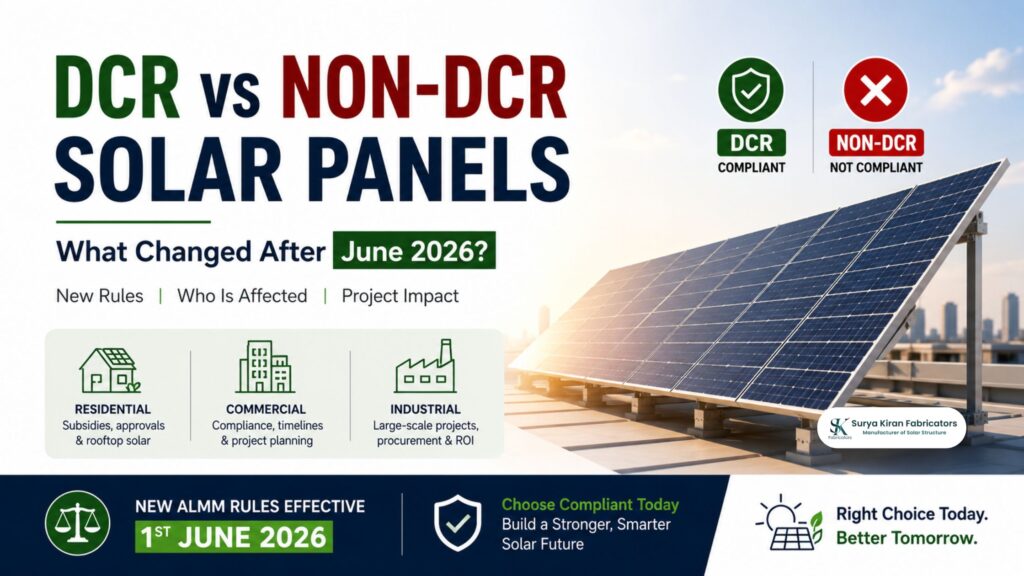
From June 1, 2026, most government-linked, net-metering, open-access, and subsidy-based solar projects in India must use solar modules manufactured with ALMM-approved domestic solar cells, making DCR compliance more important than ever.
Short Summary
- From June 1 2026 India will put into place ALMM List-II regulations.
- DCR compliant solar panels will use both approved modules and approved domestic solar cells.
- This greatly impacts subsidized residential rooftop projects.
- DCR compliance will impact commercial and industrial projects as well.
- DCR compliant modules will become increasingly available. This may affect project cost and schedules.
- An experienced EPC contractor and a good solar structure manufacturer in Rajasthan may help reduce compliance and supply-chain challenges.
2026 DCR vs Non-DCR Solar Panels Interest
There has been a huge shift within the solar industry. Conversations used to be around the performance and cost of panels. Now the conversation is focused around compliance.
In the past year the focus was how to reduce cost per watt. Now the conversation begins with, “Is this panel DCR compliant?”
This is not surprising. The Indian solar industry has moved into a phase where compliance to regulations is equally important as the performance of the generation. June 2026 will bring shifts in purchasing for homeowners, EPC contractors, commercial and industrial developers.
This is why it is so important to understand DCR vs non DCR solar panels before purchasing a solar system.
What Are DCR Solar Panels?
DCR stands for Domestic Content Requirement
Such panels have solar cells and modules built to government specifications and are therefore assembled in India.
To put it simply, DCR panels are those in which the main components are built in Indian manufacturing facilities that have been approved.
The aim is to:
- Build the solar manufacturing capacity within India
- Minimize the import of goods
- Increase the security of the supply chain
- Assist the ‘Make in India’ initiative
The Ministry of New and Renewable Energy (MNRE) reports that the ALMM has now classified approved module manufacturers (List I) and approved solar cell manufacturers (List II).
“The ALMM is a mechanism to ensure reliability while protecting consumer interests and promoting domestic manufacturing.” — MNRE
What Are Non DCR Solar Panels?
Non DCR solar panels are modules that do not abide by Domestic Content Requirement.
Such panels may be:
- Solar panels that have been fully imported
- Modules that have solar cells that have been imported
- Modules that have been built outside of the approved domestic supply chain
One of the more significant misconceptions of such panels address:
- Non DCR solar panels cannot be categorized as inferior quality panels.
- Many of the modules that have been imported are well designed and perform well.
- DCR and non DCR are panels that fulfill different requirements and regulations.
What Changed After June 2026?
This is where the real change took effect.
Introduction of ALMM List II
For years, developers largely dealt with ALMM List I, which dealt with approved manufacturers of solar modules.
However, starting from June 1, 2026, ALMM List II was applicable to a large number of projects.
That is, only approved modules was not sufficient anymore.
Solar cell manufacturers must be domestically located and government approved.
Before June 2026
- ALMM-approved modules
- Cells were imported
- Flexible procurement
After June 2026
- Approved modules
- Approved domestic cells
- DCR compliance expected
- Stricter project approval
The government has stated that there is not a general extension after June 1, 2026.
Why These New Rules?
Energy security.
India has focused funds on expanding its solar production the last few years.
The data shows that India now produces solar:
- 91 GW of modules
- 27 GW of cells
The intent of these policies is to provide some protection for Indian manufacturers in the developing solar market of India from heavy reliance on imports.
The future of solar, according to the experts, is not just in the creation of power, but also in the management of the supply chain.
That is the driving force for the DCR regulations.
Who Is Affected by the New Rules?
Residential Solar Consumers
Most directly impacted are homeowners and potential buyers of a rooftop system.
To receive government incentives or subsidies, compliance with DCR is a requirement.
Many solar system installers are recommending a DCR-approved system to sidestep the issue, and to prevent wasted resources that may go toward a system that is not DCR compliant.
Consider the Following, Homeowners
- ALMM status
- DCR compliance, certification
- Subsidy eligibility
- Net-metering
Commercial Solar Projects
Solar systems on commercial buildings face other difficulties.
Office buildings, schools, hospitals, malls, and hotels usually look at project economics first.
Under the new rules, procurement teams look at:
- Compliance
- Cost
- Availability
- Installation Timelines
From what I have seen, commercial buyers who completed procurement contracts early dealt with much less disruption compared to those who waited until the last possible moment.
Industrial Solar Projects
This will most likely affect large scale industries.
Large manufacturing units may need a lot of solar modules.
The danger is that the need for compliant products is increasing quickly.
The estimated production capacity for manufactured modules with certified cells in India is limited compared to the total capacity, which raises concerns regarding availability and cost.
“Supply security is becoming as important as panel efficiency.”
For industrial projects, procurement planning is a must.
EPC Contractors and Developers
Engineering, Procurement and Construction (EPC) contractors have additional obligations regarding compliance.
They must ensure:
- Cell Origin
- ALMM Approvals
- Double Verification
- Traceability
An error in procurement will result in either regulatory approval delays or project compliance issues.
What Is the Impact on Residential Solar Projects?
Compliance with Subsidy Criteria Is Most Important
For residential users, the focus is primarily on qualifying for the subsidy.
Using non-compliant products may lead to issues in the approval process.
Consequently, most EPC companies now offer DCR compliant solutions for residential projects.
Increased Buyer Engagement
Compared to before, homeowners are asking questions of a more technical nature.
Not long ago, conversations revolved around:
- Panel wattage
- Warranty
- Brand reputation
Now, DCR compliance has been added to these conversations.
What Does This Mean for Commercial Solar Projects?
Commercial developers must now plan to procure much earlier.
Impacts could include:
- Lead times becoming longer
- More paperwork
- Vendor vetting
- More focus on approved vendors
For large rooftop solar systems, these impacts could affect the project directly.
What Does This Mean for Industrial Solar Projects?
Industrial buyers, understandably, have strict energy cost goals.
Impacts may include changes to:
- Procurement
Developers must buy compliant stock earlier.
- Project Budgets
Higher likelihood that costs will increase due to constrained supply.
- Project Schedules
It has become challenging to mitigate risks by delaying the sourcing of solar modules until the construction of the project has begun.
Additionally, more developers are focusing on their infrastructure partners (solar structures, civil work, etc.) to help them achieve faster project execution and compliance of higher quality.
DCR vs Non-DCR Solar Panels: Which One Should You Choose in 2026?
It depends on your project.
With DCR Panels:
- You want subsidies
- You want to get net-metering
- You do government-related work
- You want to stay compliant
With Non-DCR Panels:
- Regulations allow them
- Subsidies aren’t an issue
- You want to maintain procurement flexibility
- You want to focus on project profitability
For the majority of buyers in 2026, choosing DCR panels will be a more prudent long-term decision.
This is the reason discussions comparing dcr and non dcr solar panels have transitioned from a focus on their technical prowess to a focus on regulatory planning.
Why is the Solar Supply Chain Important?
Because the success of solar doesn’t depend on the solar panels alone.
The success of a solar project is dependent on:
- the mounting systems
- the quality of the engineering
- the wind-load
- the installation
This is one reason why so many developers choose to work with a solar structures company that operates in Rajasthan, as there has been a good deal of development in the area of solar large structures manufacturing.
This guarantees that the structures will hold the solar panels in place, and, as a result, the solar panels will generate income for the project over a long period.
FAQ’s
1. Will there be a ban on non DCR solar panels in India after June 2026?
There will not be a full ban on these systems because the June 2026 laws will only apply to certain government funded, subsidized, and open access and net metering projects, wherein the project will depend on the specifics and what regulations it will be obligated to comply with.
2. What is the main dissimilarity of DCR vs non DCR solar panels?
The main dissimilarity lies in the DCR regulations and the origin of the solar cells.
3. What triggered the importance of DCR after June 2026?
With the implementation of the ALMM List-II on June 1, 2026, most projects will be required to use approved domestic solar cells.
4. Do DCR solar panels help in the generation of more solar power?
No, the difference lies in the DCR regulations and the origin of manufacturing, and not in the performance of the solar panels.
5. Is there merit in a homeowner going for DCR panels?
If a residential project intends to qualify for a subsidy from the government or net metering, then DCR panels are generally the recommended panels to use.
6. How can I ensure that a solar panel is DCR?
The easiest way is to check the ALMM listing for the solar panel, along with the manufacturing and certification documents, as well as the compliance documents prior to purchasing panels.
The discussion surrounding dcr vs non dcr solar panels has recently evolved to reflect more than just international vs national manufacturing since 2026. Now, it encompasses policy adherence, project authorizations, supply-chain assurance, and sustained investment assurance. Those who recognize the importance of these factors today will be making better solar decisions in the future.