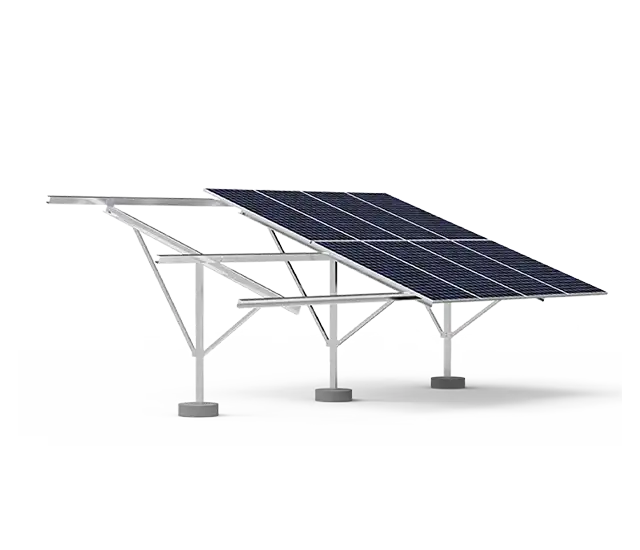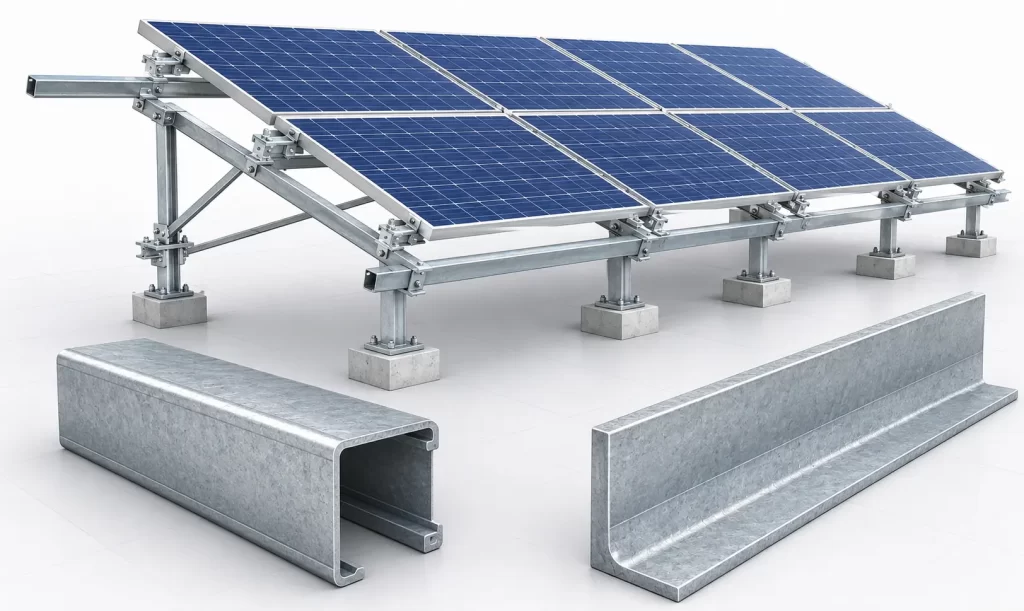
While selecting the mounting system, the two types of steel that are often considered are the C-channel steel and the angle iron steel. These two types of steel can serve as a mounting system for the solar panels but each has its own application based on the type and size of the project.
In most cases, C-channel steel solar structure will be the preferred type of mounting system for most modern projects. The angle iron steel may work well in smaller and customized projects.
Still, the choice should never be made according to price alone. Span, wind load, steel thickness, steel grade, connections, corrosion protection, spacing and installation have an impact on the serviceability and lifespan of the solar structure.
What Is a C-Channel Solar Structure?
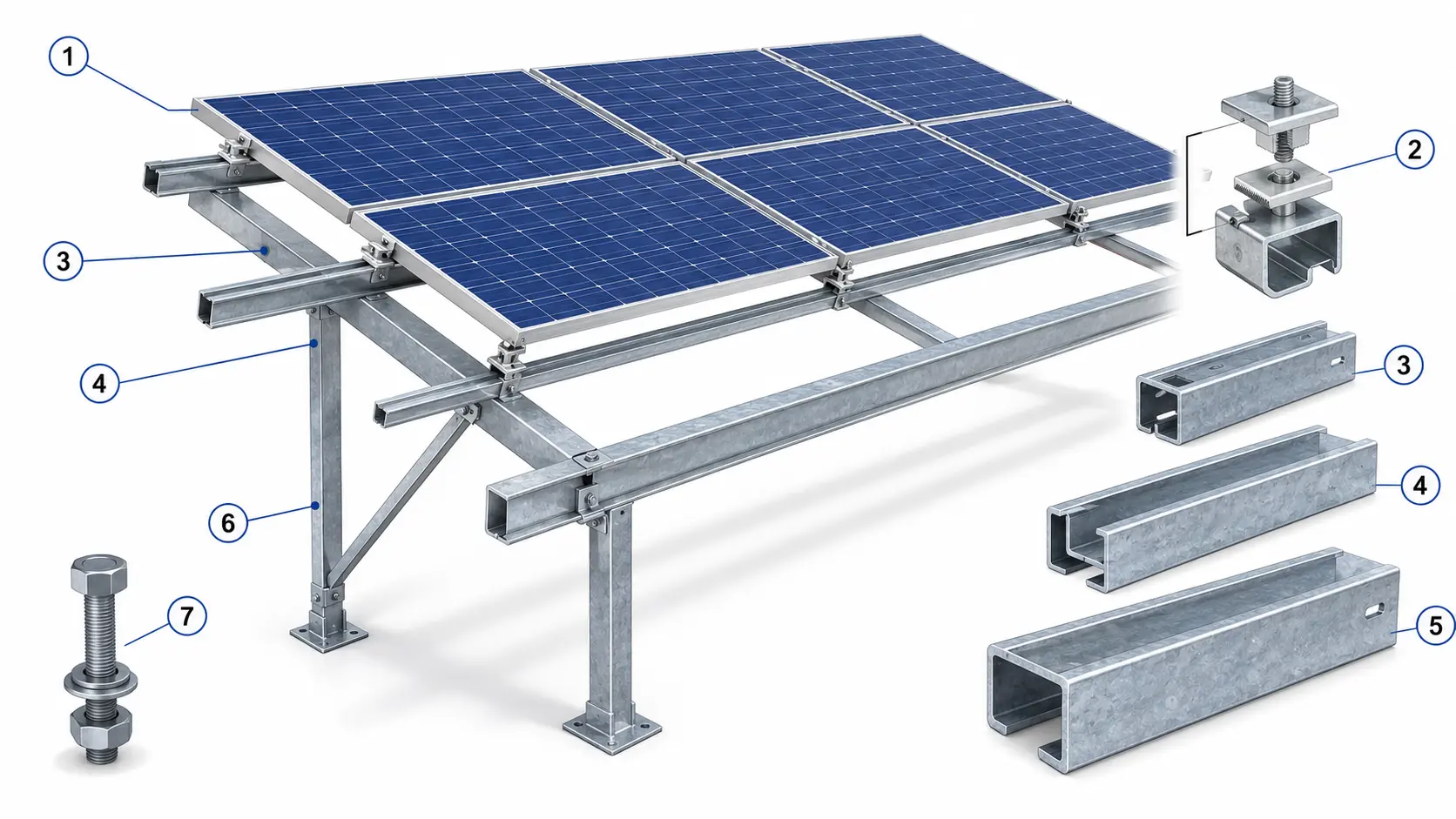
A C-channel is a structural steel section shaped like the letter “C”, consisting of a central web and two flanges. The flanges provide stiffness and create convenient surfaces for connecting other structural members using bolts, clamps or other fastening systems.
In solar mounting structures, manufacturers commonly use C-channels as part of the overall solar panel structure, including:
- Solar module rails
- Purlins supporting the panels
- Rafters
- Columns or legs in selected designs
- Bracing members
- Secondary support sections
C-channels are available in different widths, depths, thicknesses and steel grades. Based on the purpose, these may also have galvanized or hot-dipped galvanized corrosion protection systems for outdoor conditions.
What Determines the Required C-Channel Size?
There is no one-size-fits-all choice of the size of the C-channel, as it will depend on many different criteria in each project.
The main ones are as follows:
- Weight of the solar module
- Span of the structure
- Spacing of the supports
- Orientation and tilt of the panels
- Local wind load
- Roof/foundation situation
- Type of steel and its thickness
- Connection type
- Bracing scheme
- Operating conditions
A size of C-channel, which suits one structure, can be insufficient for another one. This is why it is necessary to make structural design first.
What Is an Angle Iron Solar Structure?
Angle iron, also known as angle steel, is an L-shaped structural steel section. It may have equal or unequal legs and is available in mild steel, galvanized steel and other protective finishes.
Applications for angle iron include:
- Small rooftop solar mounts
- Bracket for panels
- Bracing
- Foundation mounts
- Support structures
- Lightweight solar panel mounting
- Secondary structural components
Angle iron is still popular due to availability and ease of cutting, drilling and welding. Local fabricators are knowledgeable about the material as well, and hence is suitable for customized solar structures.
Nevertheless, performance of angle iron largely depends on how the section is oriented and connected. An angle section oriented incorrectly will have lower structural efficiency and be vulnerable to bending or twisting.
C-Channel vs Angle Iron Solar Structure: Quick Comparison
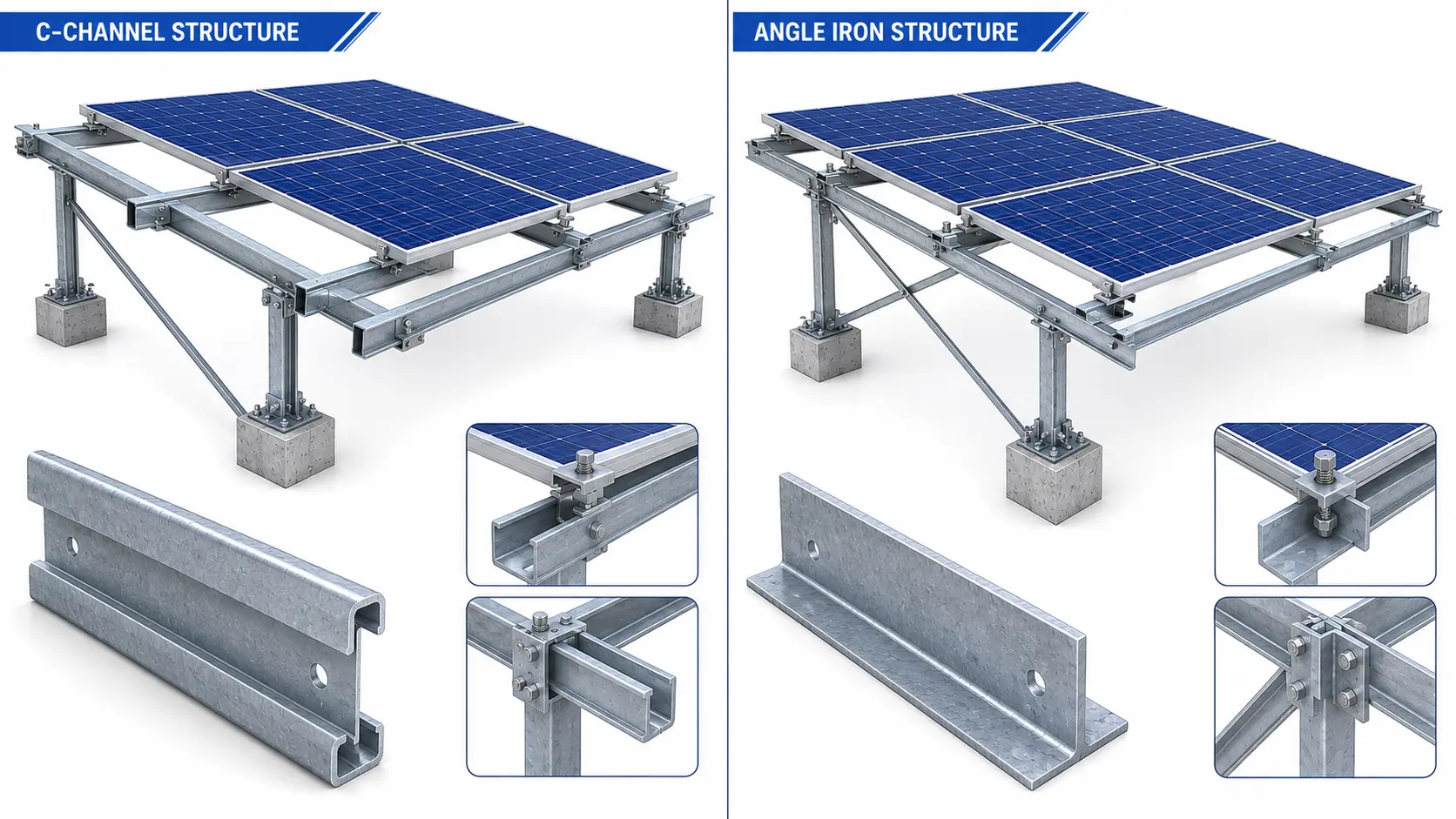
| Factor | C-Channel Solar Structure | Angle Iron Solar Structure |
| Cross-section | C-shaped | L-shaped |
| Common applications | Rails, purlins, rafters and modular supports | Brackets, bracing and small frames |
| Installation | Well suited to bolted assembly | Often involves more cutting and welding |
| Structural efficiency | Good for many beam and support applications | Effective for properly designed smaller members |
| Fabrication | Suitable for standardized production | Flexible for custom fabrication |
| Alignment | Convenient for repeated layouts | Depends heavily on fabrication accuracy |
| Initial material cost | May be higher | Often economical for smaller projects |
| Maintenance | Bolted systems can simplify inspection and replacement | Welded joints may require closer inspection |
| Commercial applications | Generally well suited | Depends on structural design |
| Best suited for | Medium, large and standardized systems | Small and customized systems |
This comparison is only meant to serve as a general guide, since structural strength varies depending on section size, thickness, steel quality, orientation, support spacing, and loading.
Strength and Load-Bearing Performance
The performance and durability of a solar structure depend not only on whether it uses C-channel or angle iron, but on the design and quality of the complete structural system.
Dead Load
Solar structures should be able to bear their own weight and the weight of all connected elements including:
- Solar modules
- C-channels or angle sections
- Rafters and purlins
- Fasteners
- Module clamps
- Cable trays
- Walkways, where provided
- Other equipment attached to the structure
Even though the solar structure might look durable, the section can be too thin and the supports placed at too long intervals, leading to deflection.
Wind Load
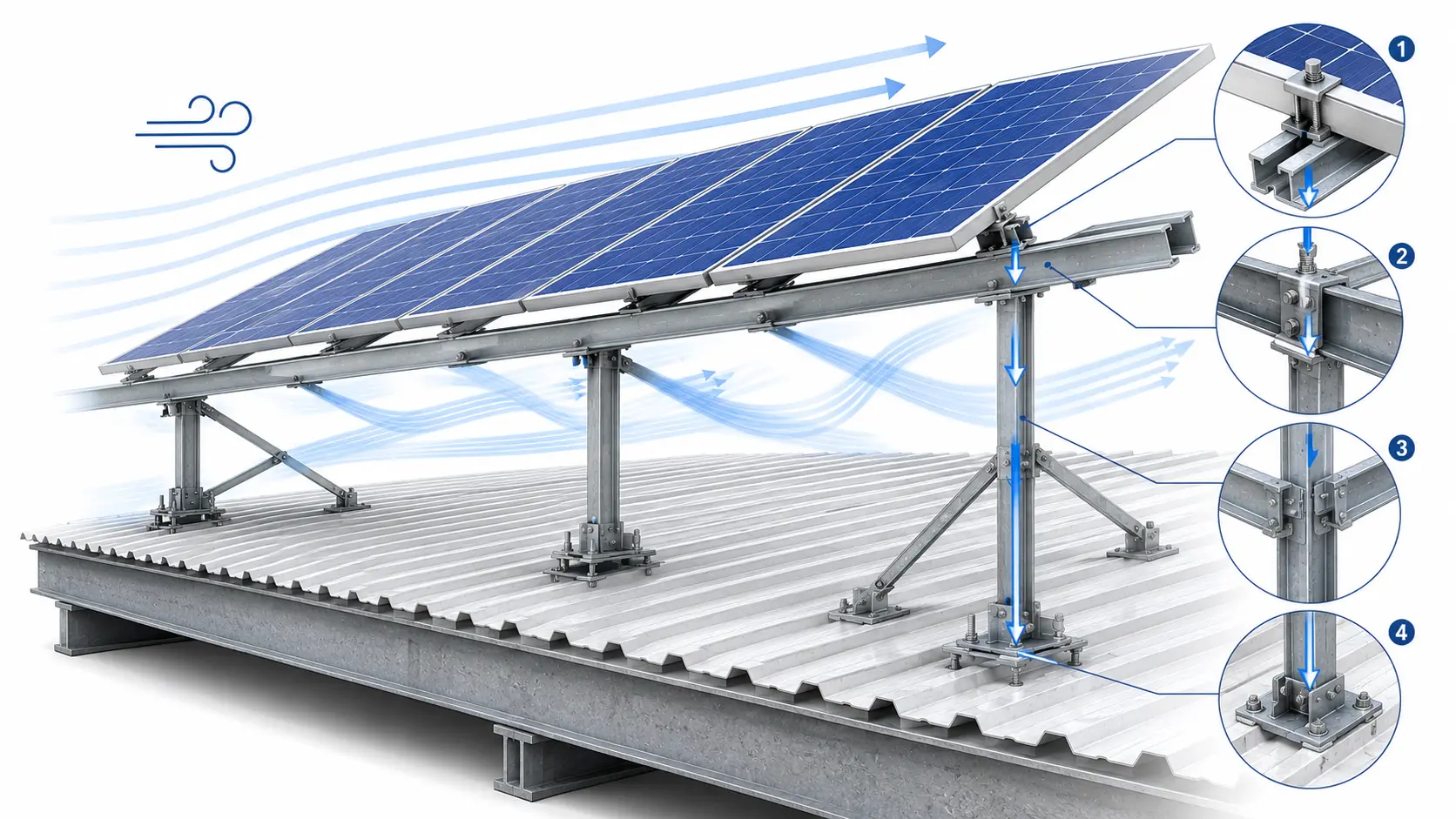
Wind is one of the most crucial factors when designing solar structures, because the solar modules provide a large surface for the impact of wind force.
The load needs to be transmitted effectively through the whole structural load path:
Solar module → module clamp → rail/purlin → rafter/support member → column/bracket → anchor/foundation/building structure
For projects in India, structural design commonly considers the applicable provisions of IS 875 Part 3 for wind loads and IS 800 for steel design, along with project-specific requirements.
Wind load design needs to consider aspects such as:
- Local design wind speed
- Building height
- Terrain
- Panel tilt
- Roof-edge location
- Array position
- Exposure conditions
- Anchorage and foundation conditions
C-channel can offer a good structural option in many cases, but a well-designed angle iron structure can effectively resist the required loads as well.
It is not only the steel section which offers resistance against wind load; anchors, bolts, bracing, connections and the roof or foundation that support the structure are equally important.
Span and Deflection
Longer lengths will need proper design of the structure. With an increase in the span, there is a possibility of increased bending and deflection.
The designer needs to consider:
- Unsupported length
- Section depth
- Steel thickness
- Steel grade
- Panel arrangement
- Support spacing
- Cantilever length
- Bracing
- Connection strength
Use of a smaller angle iron in a long unsupported length can cause too much deflection. The use of an inadequate C-channel will also create the same problem.
However, using a larger section will not always be the right approach. The entire structure will need to be designed.
Torsion and Structural Stability
Open steel sections can experience twisting when loads do not act through the appropriate structural axis.
Angle iron requires proper orientation because its structural behaviour changes with its position and loading direction.
Orientation is also important for C-channel, which needs bracing and proper orientation, since its open face direction affects its structural stability.
For both the systems, the design shall include, if required:
- Diagonal bracing
- Correct member orientation
- Appropriate support spacing
- Strong corner connections
- Properly tightened bolts
- Adequate roof attachments or foundations
C-Channel Installation vs Angle Iron Installation
C-Channel Installation
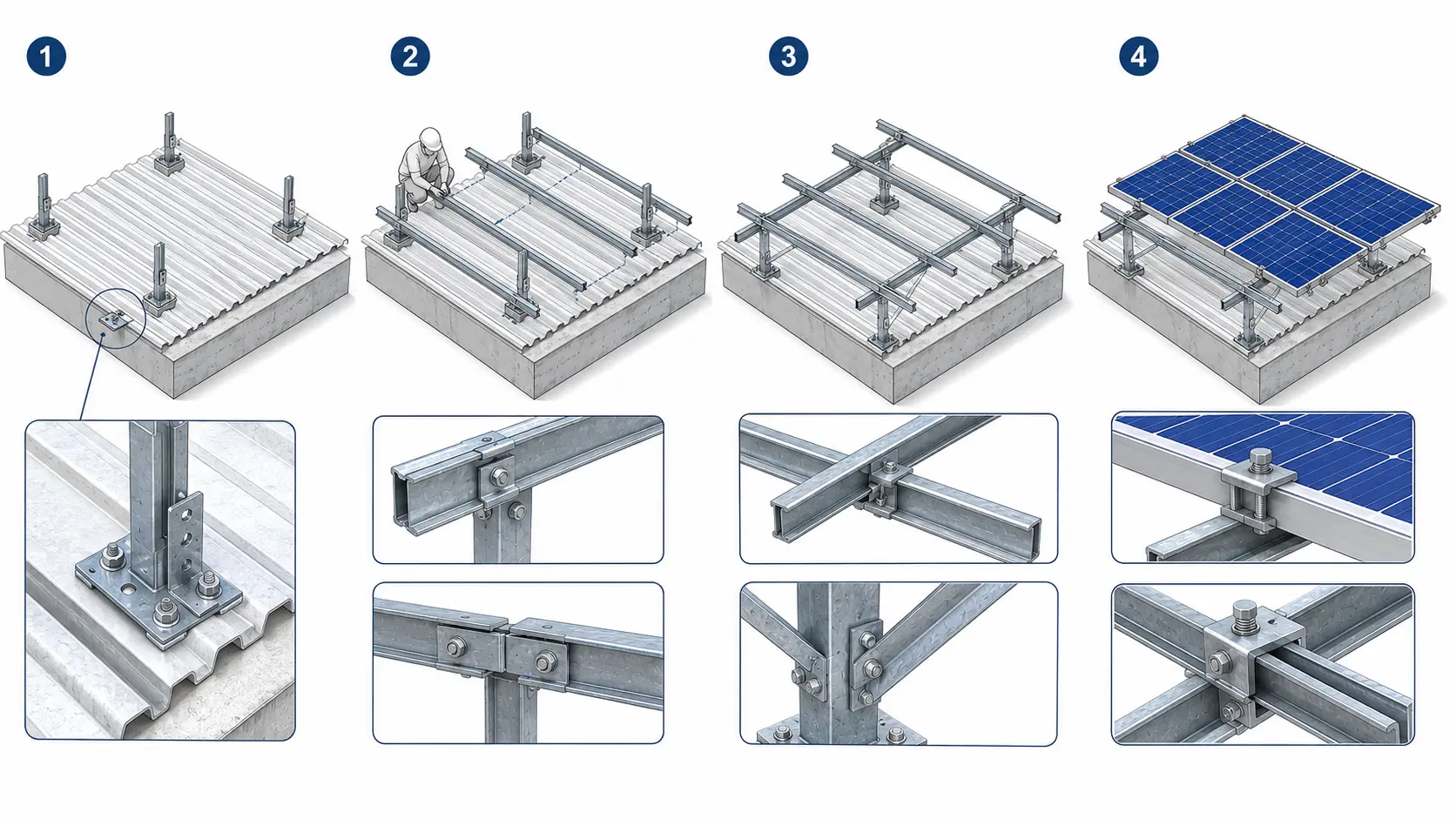
C-channel solar structures are often suitable for modular assembly using bolts, nuts, clamps and prefabricated members.
A typical C-channel installation process includes:
- Review the approved structural drawings.
- Mark support and anchor locations.
- Install base plates, roof attachments or foundations.
- Position columns, legs or brackets.
- Install rafters and purlins.
- Position and align the C-channels.
- Check levels, spacing and alignment.
- Tighten bolts to the specified requirements.
- Install module clamps.
- Position and secure the solar panels.
- Inspect the completed structure.
One major advantage of a properly prefabricated C-channel system is that it can reduce site welding and support faster, more consistent assembly.
Angle Iron Installation
Angle Iron structure often needs more fabrications before erection.
The usual procedure is as follows:
- Cut the angle sections after measuring.
- Drill holes for bolted connections or prepare the members for welding.
- Erect the frame based on the drawing.
- Check dimensions, diagonals and squareness.
- Install bracing and support members.
- Protect cut and welded areas against corrosion.
- Fix the frame on the roof or foundation.
- Secure the structure.
- Install the solar panels.
- Check connections and coatings.
Angle iron can perform well when it is fabricated and installed according to an approved structural design. Issues usually arise where there are unsupervised installations by the installer, where there are irregular dimensions, poorly done welding, and inadequate bracing.
Which Is Easier to Install?
Where modular and standardized solar structures are being built, C-channel works better with bolts.
Angle iron is just as practical for a customized frame, especially when the fabricator has already prepared the members.
Installation efficiency is not only dependent on the steel section. The other considerations are:
- Factory prefabrication
- Number of joints
- Site accessibility
- Available tools
- Workforce skill
- Roof type
- Design complexity
- Material handling requirements
Thus, the most suitable option will be the one that achieves the required combination of all of these aspects.
C-Channel vs Angle Iron: Cost Comparison
Looking at the price per kilogram of steel only will result in an incorrect inference.
The total cost of a solar structure may include:
- Steel material
- Cutting
- Drilling
- Welding
- Galvanization or painting
- Bolts and fasteners
- Transportation
- Labour
- Roof attachments
- Foundations
- Installation
- Maintenance
Angle iron may have a lower material cost for smaller projects, but additional fabrication, welding, coating and installation requirements can increase the total installed cost.
On the contrary, a C-channel construction will cost more in terms of material cost but it may minimize fabrication and installation costs.
A better comparison is:
Total installed cost = material + fabrication + coating + fasteners + transportation + installation + maintenance
While comparing the quotations from the solar structure supplier, ensure that the quotations use similar specifications in terms of steel thickness, steel grade, steel coating, fasteners specification, design scope and installation requirements.
Corrosion Protection and Service Life
Solar mounting structures remain exposed to outdoor conditions for many years. Therefore, corrosion protection is just as important as structural strength.
Galvanized Steel and Hot-Dip Galvanizing
Galvanized steel employs zinc as a protective layer against corrosion of the underlying steel. Hot-dip galvanizing can provide a robust zinc coating suitable for demanding outdoor environments when the material and process meet the required specifications.
Protection should cover all important structural components, including:
- C-channels
- Angle sections
- Fasteners
- Brackets
- Base plates
- Welded areas
- Cut edges
- Drilled areas
Cutting, drilling and welding can damage protective coatings. Exposed steel should therefore be appropriately treated according to the specified corrosion-protection system.
When purchasing a solar structure, don’t assume that every product labelled “GI” has the same corrosion resistance. Ask the supplier about the steel specification, coating requirements and quality-control process.
Solar Structures in Rajasthan: What Matters?
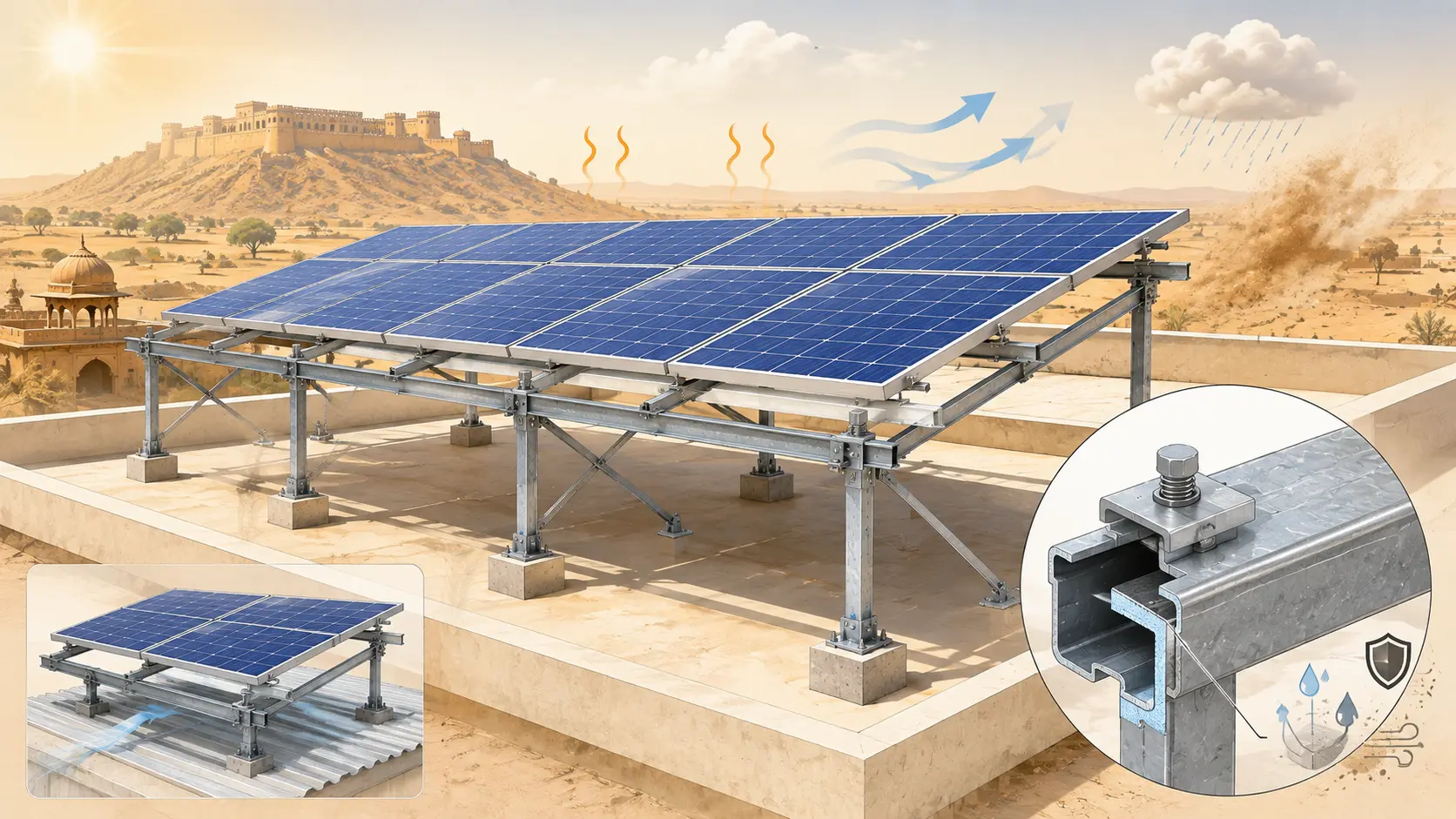
Solar structures installed in Rajasthan may experience demanding environmental conditions, including:
- High summer temperatures
- Dust and sand
- Strong winds
- Thermal expansion and contraction
- Seasonal rain and moisture
- Difficult maintenance conditions
Agricultural and industrial environments may also expose structures to additional moisture, chemicals or other corrosive conditions.
Proper drainage, suitable coatings, well-designed connections and regular inspection can help improve service life.
For any construction project in Rajasthan, one needs to design the structure based on the site condition and not just by using a generic frame.
Rooftop Solar Applications
In the case of roofs, the structure has to complement the building and roof itself.
Important considerations include:
- RCC or concrete roof
- Metal sheet roof
- Tile roof
- Existing roof load capacity
- Waterproofing
- Anchor pull-out capacity
- Parapet and edge distances
- Maintenance access
- Wind uplift
C-channel can be used for standard rooftops where rails, purlins, and bolts are needed.
Angle iron may also be considered for smaller units as well as customized bracketry and secondary supports.
It should never be drilled or anchored into a roof without considering its structure, waterproofing, and attaching methods.
Ground-Mounted Solar Applications
Ground-mounted solar structures require additional consideration of:
- Soil conditions
- Foundation depth
- Column spacing
- Wind exposure
- Corrosion near ground level
- Uneven terrain
- Drainage
- Access for cleaning and maintenance
C-channel may be used for purlins and rafters, while angle iron can be used for bracing or secondary members.
The right configuration should always depend on the design of the structure.
Advantages and Limitations of C-Channel
Advantages
- Efficient in many structural applications
- Convenient to make bolted joints
- Suited for modular construction
- Good alignment for repetitive panels
- Galvanizing option available
- Suited for commercial and industrial structures
- Can reduce field fabrication if prefabricated
Limitations
- May have a higher initial material cost than angle iron
- Should be correctly oriented
- Tends to deflect if under-sized
- Requires appropriate corrosion protection
- Not all light channels are suited as primary structural components
Advantages and Limitations of Angle Iron
Advantages
- Widely available
- Easy to cut and fabricate
- Often economical for small projects
- Useful for brackets and bracing
- Flexible for customized designs
Limitations
- May require more weldings
- Quality of fabrication is not consistent
- Improper placement may result in inefficiency in construction
- Proper protective coatings are required for welding joints
- Longer span may require more sections and bracing
Which One Should You Choose?
Choose a C-Channel Solar Structure When:
- You are constructing medium or large-scale solar arrays.
- You prefer the use of modular bolted construction.
- The project involves repetitive panels.
- You need proper alignment.
- Future adjustment is necessary.
- Design-based specifications can be provided by the supplier.
- Unnecessary field fabrications should be minimized.
Choose Angle Iron When:
- The system is comparatively smaller in size.
- Shorter spans are involved.
- Customized structure is required.
- A qualified fabricator is available.
- Proper bracing can be done.
- Proper protection can be given to cut and welded parts.
- The angle sections are mostly being used as supports.
What to Ask a Solar Structure Manufacturer Before Ordering
Whichever option you choose whether it is a C-channel or angle iron, make sure that you receive adequate technical data from your supplier before ordering it.
Check:
- Structural drawings
- Section dimensions
- Steel grade
- Material thickness
- Galvanization specification
- Wind-load design basis
- Support spacing
- Fastener specifications
- Roof or foundation details
- Fabrication specifications
- Quality inspection procedure
- Warranty conditions
- Previous project references
A reputable solar structure manufacturer in Rajasthan would definitely be able to justify the use of specific sections and connections for your specific project.
Common Mistakes to Avoid
Avoid these mistakes when selecting or installing a solar mounting structure:
- Choosing a section only because it is cheaper
- Using the same section size for every project
- Ignoring local wind conditions
- Using thin sections over long spans
- Omitting required diagonal bracing
- Using weak or mismatched fasteners
- Leaving cut or welded areas unprotected
- Failing to check roof capacity
- Ignoring waterproofing
- Mixing dissimilar metals without suitable isolation
- Changing the approved design at the installation site
- Skipping bolt and weld inspections
- Assuming all galvanized products have identical coating performance
- Using a rooftop design for a ground-mounted application
Frequently Asked Questions
Is C-channel stronger than angle iron?
Not necessarily. It all depends on their size, thickness, type of steel used, orientation, span, connections and loading conditions. The right design of angle iron sections can actually be stronger than the wrong design of C-channel sections.
Is C-channel better for rooftop solar?
In most cases where there are standard rooftop installations of solar panels, the use of C-channel is advisable due to its modularity and ease of joining through bolts. However, the decision will depend on the structural design and the roof.
Is angle iron suitable for solar panels?
Yes. The use of angle iron is appropriate in light structures as long as it is of the right size and orientation, supported, properly connected and protected against corrosion.
Which is cheaper: C-channel or angle iron?
Angle iron may be less expensive initially as far as the material itself is concerned, especially in small installations. Nonetheless, the overall project cost includes material, fabrication, painting, fastening, transport and installation.
What is more important than choosing C-channel or angle iron?
It is the design of the structure as a whole that matters more than just the name of the part. The wind load, span, distance between supports, steel plate thickness, connections, anchoring, corrosion protection, and installation quality will determine the strength and longevity of a solar structure.
Final Verdict: C-Channel or Angle Iron?
C-channel is often a better fit for many of today’s rooftop, commercial and standard solar panel mounting systems because of its shape, modularity, bolted joints and ability to form arrays repeatedly.
Angle iron can be a practical and cost-effective choice for smaller or specialized solar structures when properly designed and fabricated, but it may be less suitable for larger standardized systems.
The real question is not simply:
“Which steel section is stronger?”
The better question is:
“Which section has been correctly designed for this site, load, span and installation method?”
Any reliable solar structure manufacturer should be able to offer more than just a quote for the material. The supplier should be capable of detailing the steel specification, section sizes, coating process, wind loading basis, connection type, and anchorage method.
This is what distinguishes a reliable solar mounting structure from one that begins showing signs of wear after its first major wind or monsoon event.
If you are comparing C-channel suppliers or solar structure manufacturers in Rajasthan, evaluate them on engineering capability, material quality, manufacturing accuracy, corrosion protection and installation support not price alone.