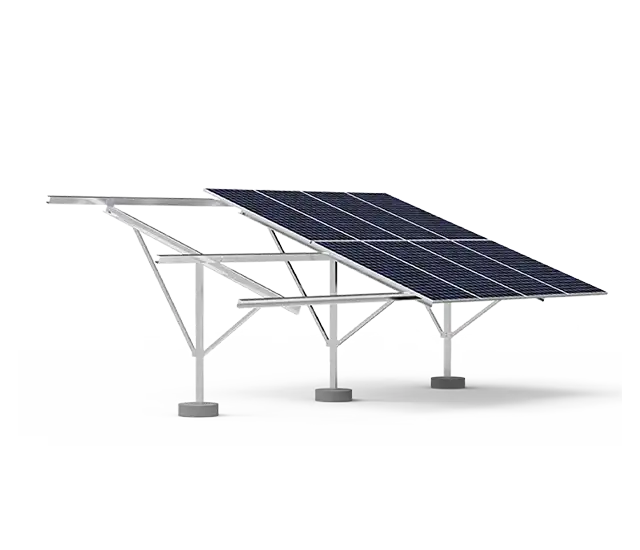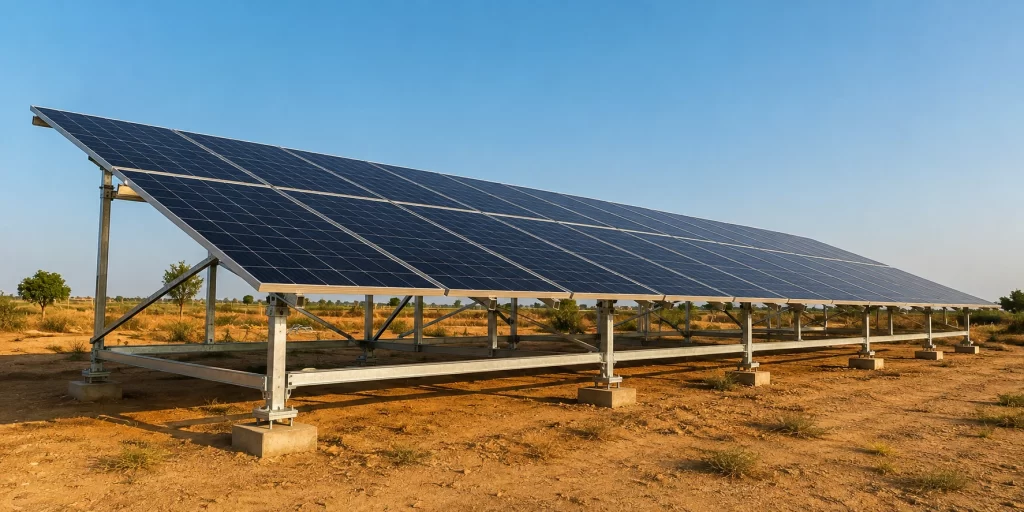
You must have noticed those black panels installed on the roof top, factory and even open spaces. However, have you ever thought about what is there in that panel?
Though it appears to be one whole entity, there is more to the solar panel structure than meets the eye because the solar panel has layers that serve certain functions such as providing protection to the solar cells, letting sunlight through, preventing moisture penetration, and generating power.
And there is one more thing that should be clarified.
The structure of a solar panel and a solar mount structure are different notions. The former refers to the panel itself, while the latter refers to the system of panels’ installation.
This manual will describe both designs with a focus on their basic elements, materials, types of solar panels and criteria of solar mount systems selection.
What Is a Solar Panel Made Of?
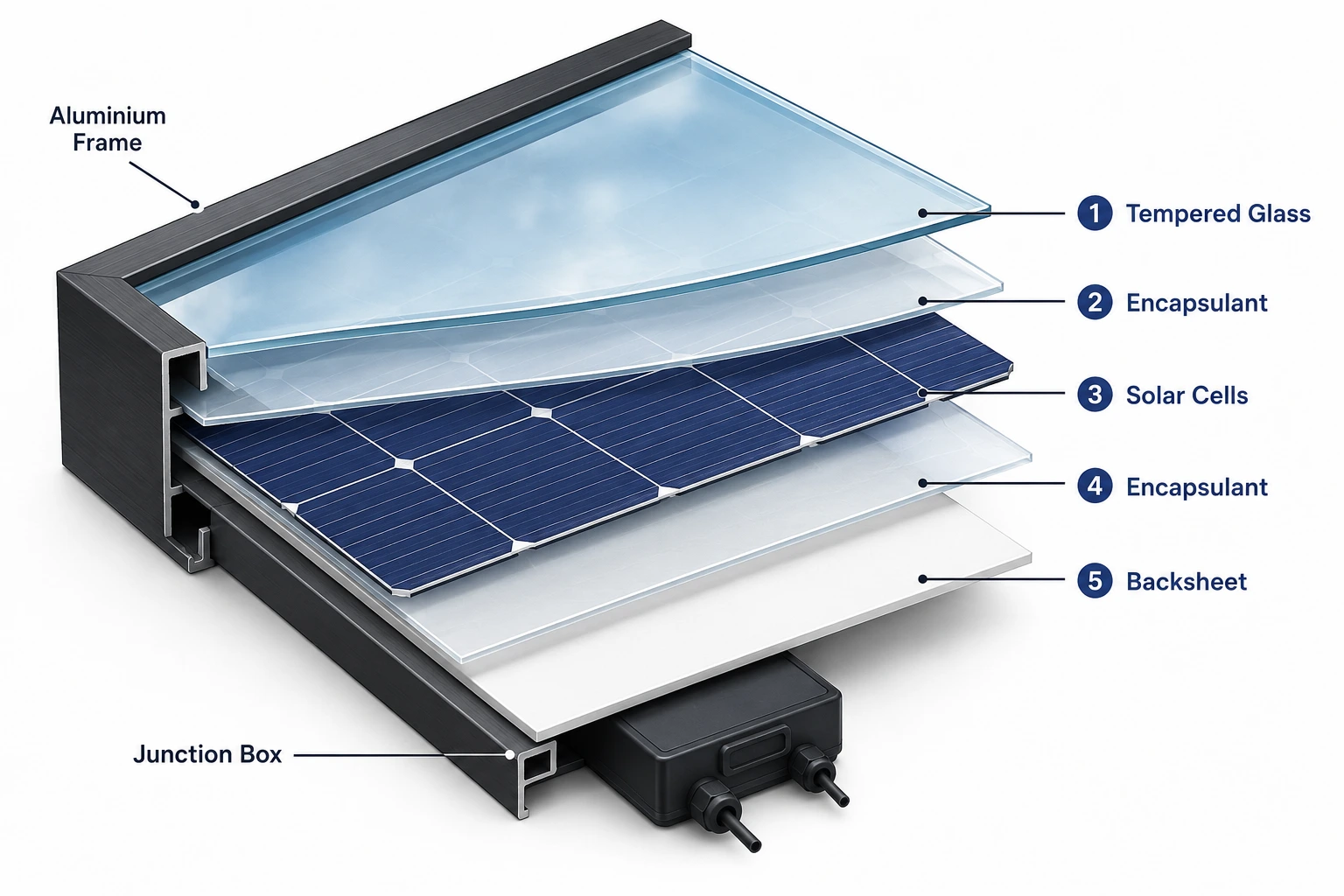
The traditional structure of a solar panel consists of several layers.
Arranged from front to back, the structure consists of the following elements:
Tempered Glass → Encapsulant → Solar Cells → Encapsulant → Backsheet
These layers are enclosed by an aluminium frame that holds the whole structure together. A junction box at the rear side of the structure deals with the electrical connections.
Each of these components serves a particular function: glass protects the structure, encapsulant encapsulates the cells, solar cells create power, and backsheet protects the rear side.
Let’s look at each component.
Structure of Solar Panel: Layer by Layer
Tempered Glass
The glass acts as the outermost part of the typical solar panel.
Its primary role is to shield the solar cells from exposure to elements such as rain, dirt, physical damage, and changes in temperature, while ensuring that sunlight passes through to the cells.
Solar cells usually use special tempered glass instead of regular glass. This glass is meant to offer strength while still transmitting adequate light.
In some cases, there is anti-reflective coating used to minimize reflection.
EVA Encapsulant
EVA stands for Ethylene Vinyl Acetate.
The encapsulant is a clear substance that surrounds the solar cells. It ensures that the cells remain in their position and attach themselves to the surrounding materials.
More importantly, it protects the cells from the effects of moisture and any other environmental elements.
While there have been some changes in the materials used for encapsulation recently, the main function has not changed much.
Photovoltaic Solar Cells
This is where actual conversion of sunlight to energy takes place.
Most conventional solar cells are made from silicon. When sunlight reaches the cell, it creates an electrical current through the photovoltaic effect.
A single cell produces a relatively small amount of power, so many cells are electrically connected inside a module.
This is the reason why phrases like monocrystalline, polycrystalline, PERC, TOPCon, and HJT will come up when comparing solar panels.
Backsheet
The backsheet acts as the protective layer that covers the backside of many traditional solar panels.
It serves as an electrical insulator and protects the cells against moisture, dust, and other environmental factors.
All panels do not have a polymer backsheet. Modern bifacial modules employ a glass-glass design, wherein glass is used for both the front and the back side.
This allows light to reach the rear side of bifacial cells.
Aluminium Frame
The aluminium frame supports the panel from all sides and gives it mechanical rigidity.
It acts as protection for the edges of the glass and assists in keeping the panel’s shape intact when being transported and installed.
The frame serves as a mount point for fixing the panel on rooftops and ground-based mounts.
Aluminium is used because it is light-weight, strong, and resistant to corrosion.
Junction Box and Wiring
The junction box is mounted at the back side of the panel.
It contains electrical connections and consists of bypass diodes. Cables that originate from the junction box connect the panel to other panels in the entire solar system.
The box is airtight to prevent exposure of the electrical elements to the external environment.
Materials Used in Solar Panel Construction
Various materials combine in the fabrication of the solar panel.
Silicon
Silicon is the main material used in most conventional solar cells.
Monocrystalline silicon uses a single crystal structure and is widely used in high-efficiency modules.
Polycrystalline silicon uses multiple crystal structures and was traditionally a more economical option.
Modern solar manufacturing has increasingly moved toward higher-efficiency monocrystalline technologies.
Thin-Film Materials
Thin-film panels employ photovoltaic cells made of extremely thin layers rather than the traditional silicon cells.
Common thin-film technologies include:
They may prove to be beneficial in applications that need lightweight cells or certain shapes, even though they are less efficient in terms of area requirements than crystalline-silicon cells.
Glass and Encapsulant
Glass acts as a protective layer that also allows sunlight into the cells.
Encapsulant surrounds the cells and is responsible for sealing them within the module.
All these serve the purpose of protecting the most vital component of the panel from external factors.
Aluminium
The aluminium is mostly used in making the frame.
This metal is light-weight, strong and not corroded by water thus suitable for solar use outdoors.
Types of Solar Panels and Cell Technologies
The solar cells are not produced in the same manner.
Some variations are dependent upon the silicon employed in the production process whereas others pertain to the cell technology itself.
Monocrystalline Panels
Monocrystalline panels feature solar cells that have been made using a single crystal of silicon.
They tend to be highly efficient, with excellent output per square meter, making them very common where there is limited roof space.
Polycrystalline Panels
The polycrystalline panels employ silicon in different crystalline formations.
They have been employed extensively due to their economic benefits, although modern solar plants mostly use advanced monocrystalline systems.
Thin-Film Panels
Thin film panels make use of a thin layer of photovoltaics instead of traditional silicon wafers.
The advantages of being light in weight allow for specialized applications, but at the same time, low efficiency requires more installation space.
Bifacial Panels
Power can be produced from the front side and backside of bifacial solar panels.
This is because they are ideal for applications where there is an opportunity for light to be captured from the back of the solar panels, such as certain elevated ground-mounted systems.
The amount of extra power production will depend on several factors. When combined, these materials provide the solar panel structure material and solar panel structure design that will determine its lifetime in the field.
PERC, TOPCon and HJT
These are the names of the cell technologies and not a name of entirely new types of panels.
PERC technology improves the performance of cells through passivation from the back side.
TOPCon technology utilizes a passivated contact approach and has become very common in the production of modern high efficiency modules.
HJT, also known as heterojunction technology utilizes different semiconductor materials to get high efficiency performance.
While comparing panels, one must not depend on just the technology name. The module efficiency, warranty, temperature behavior, degradation rate and manufacturer should also be considered.
Solar Panel Structure vs Solar Mounting Structure
This is where things can get confusing.
The structure of the solar panel means the internal parts of the panel.
The solar mounting structure means the outer structure that supports the panel.
Think of it this way:
Panel structure = the panel.
Mounting structure = what holds the panel.
The mounting system affects the positioning, angle, and attachment of the panels to the roof or the ground.
It must also be capable of handling the load imposed by the panels themselves and environmental loads on the structure.
Types of Mounting Structures for Solar Panels
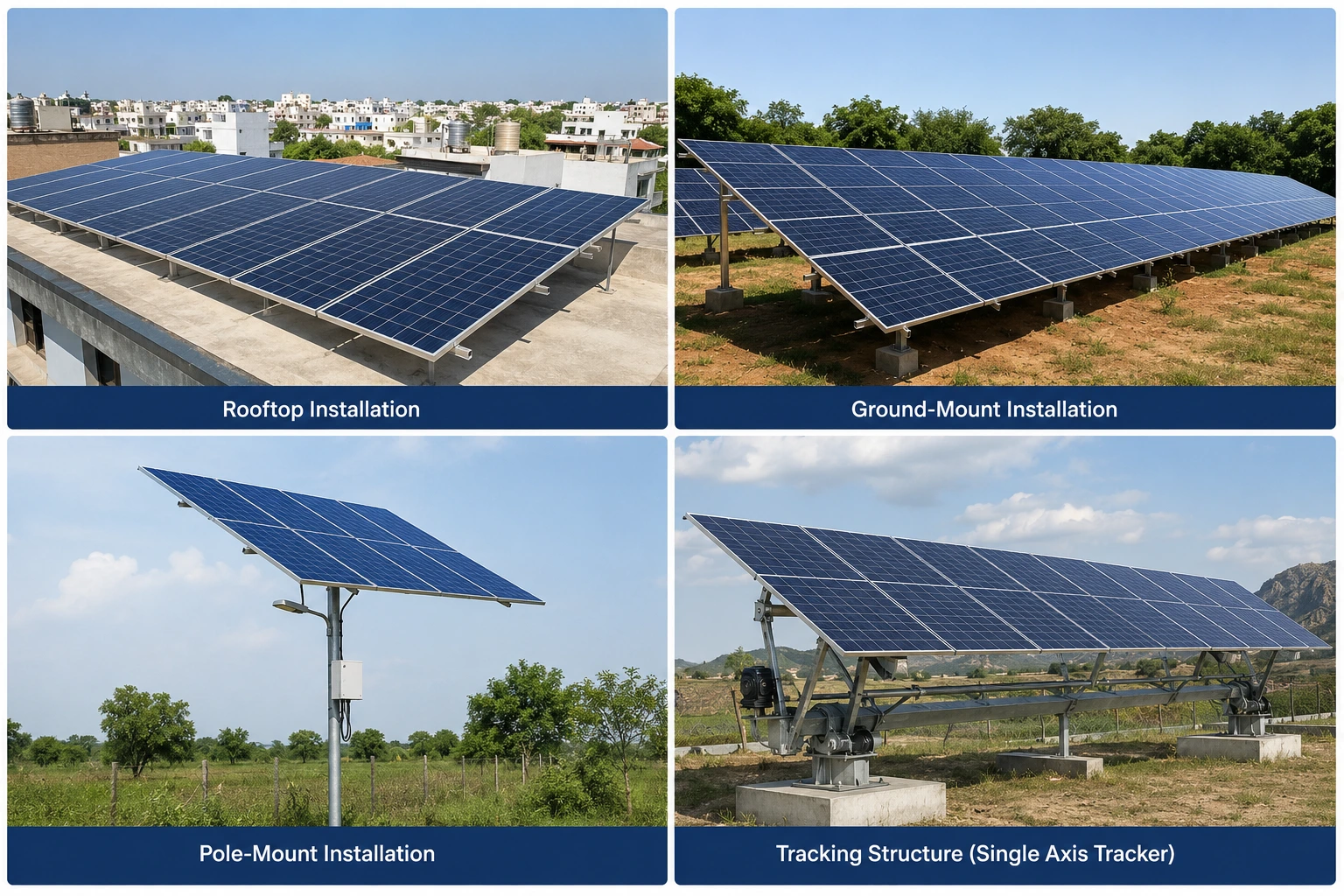
The right solar module mounting structure depends on where the panels will sit and how much space you have.
Rooftop Mounting Structure
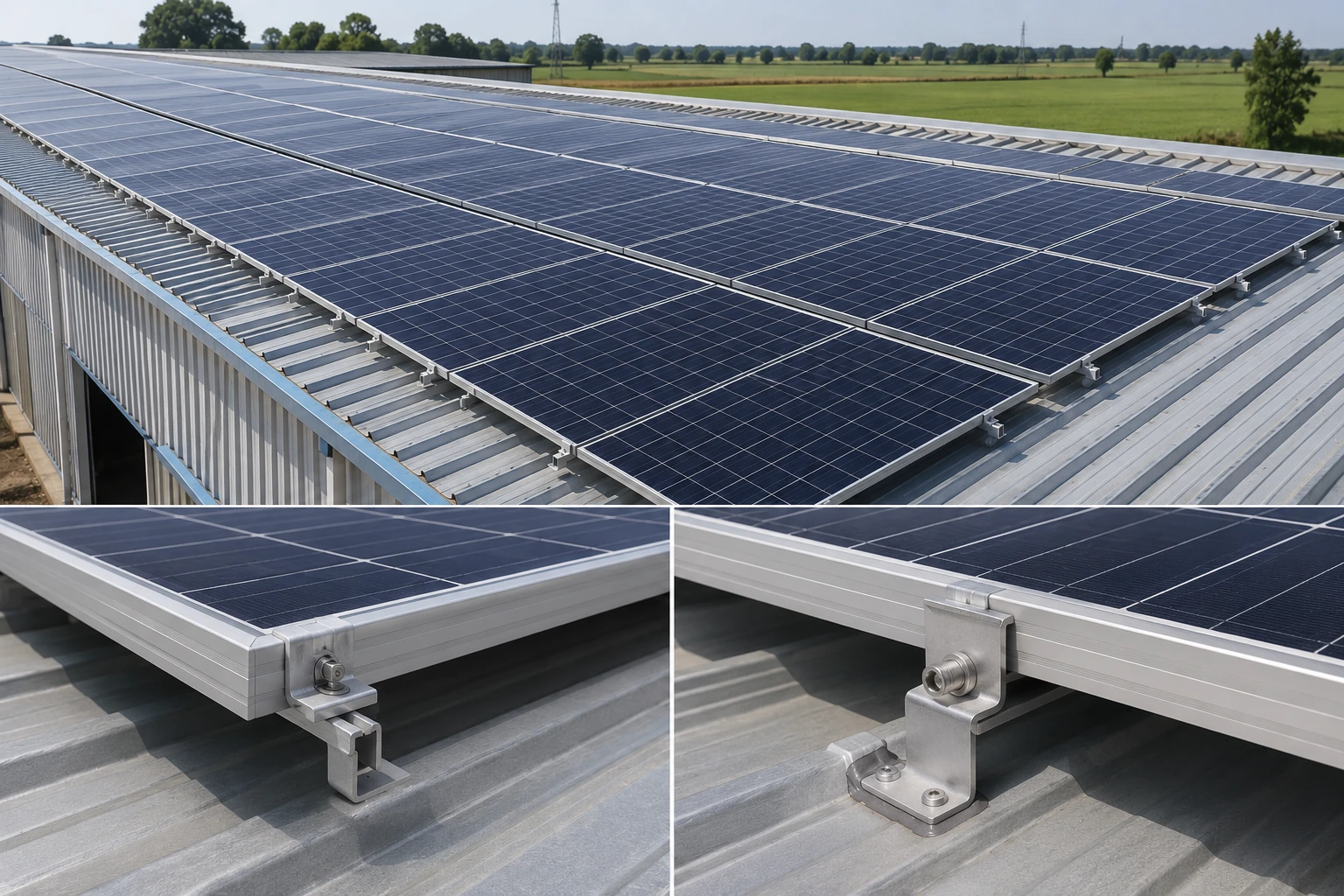
Such mounting systems are installed on the roofs of houses and buildings. Whether it be a house, industrial shed or commercial roof, the rooftop solar structure design should take into consideration the shape of the roof, the size of the roof, the layout of the panels, and the way it is attached, because all rooftop solar panel mounting structures are different.
In Rajasthan, one such example of a tin shed solar structure would be the metal sheet roof solar mounting structure wherein panels are installed in factories, warehouses, and farm sheds using metal sheets. This requires special fixation without puncturing or weakening the sheets and uses specialized clamps/brackets for the installation of panels in corrugated/trapezoidal roofs.
Ground-Mount Structure
The fixed ground mounted solar structure is one that is anchored to the foundations, which have been established into the ground and not onto the roof. The solar ground mounting structure is typical of areas with plenty of land space.
They are common where sufficient open land is available and can provide greater flexibility in panel orientation, spacing, and maintenance access.
Pole-Mount Structure
Pole-mounted systems are mounted vertically to position the panels above the ground.
They’re useful for small systems or situations where a ground-based system cannot be utilized.
Tracking Structure
The tracking systems involve mounting panels in a way that allows them to track the sun.
While single-axis trackers operate on one major axis, dual-axis trackers operate on two axes.
Tracker systems may help to enhance energy harvesting, but they are expensive and prone to wear and tear.
Materials Used in Solar Mounting Structures
Choosing the right solar structure material affects how long the structure lasts outdoors. Solar mounting structures are commonly made using mild steel, galvanized steel, hot-dip galvanized steel, and aluminium.
Mild Steel
Mild steel is quite durable and relatively inexpensive; however, proper corrosion resistance measures should be taken before exposing it to the environment.
Galvanized Steel
Galvanization is a process that involves coating of steel with zinc in order to prevent the formation of rust on steel.
Hot-Dip Galvanized Steel
Hot-dip galvanization ensures a protective zinc layer through dipping steel parts into melted zinc, which is regulated in India by IS 4759:1996, the Bureau of Indian Standards hot-dip zinc coating standard for structural steel.
It’s widely used for outdoor construction due to its anti-corrosion property.
But coating alone is not sufficient. All other factors like steel thickness, grade, fabrication, joints, and structural design are important.
C-Channel and Other Structural Profiles
Not only does the coating play an important part, but the shape of the steel is crucial as well. The c channel solar structure consists of C-shaped steel channels which act as the primary structural components due to their weight-to-strength ratio, as well as because of their easy bolt-on nature to the panels and purlins.
Aluminium
An aluminium solar structure installation is very light and rust-resistant. Such an solar aluminium structure installation would be effective to use in mounting systems where lightness is important, like roofs that have less load-carrying ability.
Why Solar Structure Quality Matters
The solar panel can be perfect, but it still needs an appropriate structure underneath it.
The structure should be able to carry the load of the panels, bear wind load, keep up the required inclination angle, and withstand all throughout its life span.
This is particularly relevant in Rajasthan, as solar structures are subjected to intense sun rays, heat, dust, and changing weather conditions.
A good structure does not have to be necessarily bulky or massive in nature. The solar structure design is about using the right materials, right thickness, right anti-corrosion and connectivity.
This is the reason why selecting a solar structure supplier or manufacturer in Ganganagar cannot be solely based on the price.
How to Choose a Quality Solar Panel and Structure
Before buying, check these basic points:
- Specifications of the panel
Consider efficiency, power output, degradation rate, warranty, and temperature characteristics. - Material quality
Regarding the mounting structure, inquire about steel grade, thickness, coating, and manufacturing process. - Rust resistance
An outdoor structure requires adequate rust and environment protection. - Load-bearing capacity
The structure needs to be designed considering the wind load of the location and other relevant factors. - Installation quality
Even the best material may yield poor results if not manufactured or installed properly. - Supplier experience
A supplier experienced in local conditions will understand practical problems associated with weather, manufacturing, and maintenance.
Looking for a Solar Structure Supplier in Ganganagar?
If you are planning to install solar in Ganganagar (Sri Ganganagar) or nearby areas like Hanumangarh, Sadulshahar, Abohar and Sangria, the structure is as important as the panels themselves. Not all solar structure manufacturers work to the same quality standard, so it’s worth comparing more than just price.
An efficient manufacturer should be able to give you appropriate material, proper manufacturing, corrosion resistance, and a structure that suits your installation.
For instance, if you require a solar structure manufacturer in Ganganagar(Rajasthan), you can compare manufacturers on various aspects like material quality, manufacturing, prior projects, delivery and customer service and not only on cost.
In case of large installations, you can also consider the type of structure, i.e., rooftop or ground mount.
FAQs
What is the structure of a solar panel?
A typical solar panel includes tempered glass, an encapsulant, the photovoltaic cells, yet another encapsulant, and normally a backsheet. The aluminium frame and junction box are included in the basic design of the module.
What material is used in solar panel structures?
Materials used for the panel include silicon, glass, encapsulant, polymer materials, and aluminium. Materials used for the mounting structure are usually steel, galvanized steel, hot-dipped galvanized steel, and aluminium.
Which solar panel is best for a home?
High-efficiency mono-crystalline solar panels would be an appropriate choice for some houses due to the small space in their roofs. It will always depend on the amount of space available, budget, power needs, and type of equipment.
How long does a solar mounting structure last?
The proper design and correct coating of the mount will ensure that the mount lasts for a very long time; however, the actual period of time depends on the type of coating and grade of steel used as well as the weather exposure of the installation site.
What is the difference between rooftop and ground-mount structures?
Rooftop installations are mounted on buildings while ground mount installations are mounted on foundations that are situated on the ground. Ground mount systems provide more flexibility when it comes to layout and orientation, although land and foundations must be present.
Final Takeaway
A solar panel is not merely a piece of glass containing solar cells.
It is rather a blend of protective layers, photovoltaic cells, electrical parts, and structural material that altogether generate electricity and can survive many years of exposure to the elements.
The structure behind them also counts.
A good solar mounting structure ensures proper installation of solar panels and allows them to perform under various weather conditions, such as strong winds, high temperatures, dust, etc.
Thus, when you are considering the options of solar panels or are searching for a solar structure manufacturer in Ganganagar, do not limit yourself by price only. Consider also the quality of materials, technical specifications, design, anti-corrosion measures, and quality of installation.
And that is how the gap is created between simply fitting solar panels and creating a durable solar system.