Solar energy has become a highly preferred source of electricity generation. Solar energy setups are classified into on-grid, off-grid and hybrid solar system.
A standard on-grid setup is limited only to accessing local utility power when needed, meaning it shuts down during a power cut even on sunny days. Further, an off-grid system can store surplus solar energy, but is not functional when panels are incapable of generating enough electricity and the storage banks are depleted.
A hybrid solar system addresses the drawbacks of both on-grid and off-grid solar systems by storing excess electricity, while drawing utility grid power when solar energy production and battery reserves fall short.
Hybrid Solar System: Key Takeaways
- Hybrid system includes solar PV, battery storage, hybrid inverter and the grid.
- Solar energy will supply energy for your loads directly as well as charge the battery.
- Energy from the battery will come into use if there is no solar energy available.
- Grid energy will come to support solar and battery energy.
- Backup-enabled hybrid systems will ensure that the load you want to remain active during the power outage stays operational.
- kW is the measure of power and kWh is the measure of energy or battery.
- The size of the system is dependent on your energy usage and peak demand.
What Is a Hybrid Solar System?
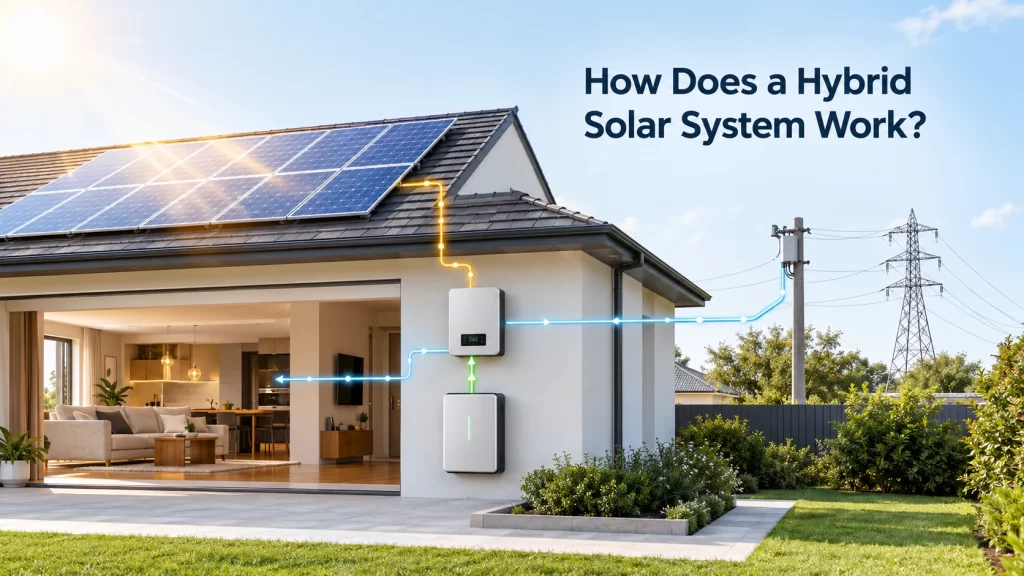
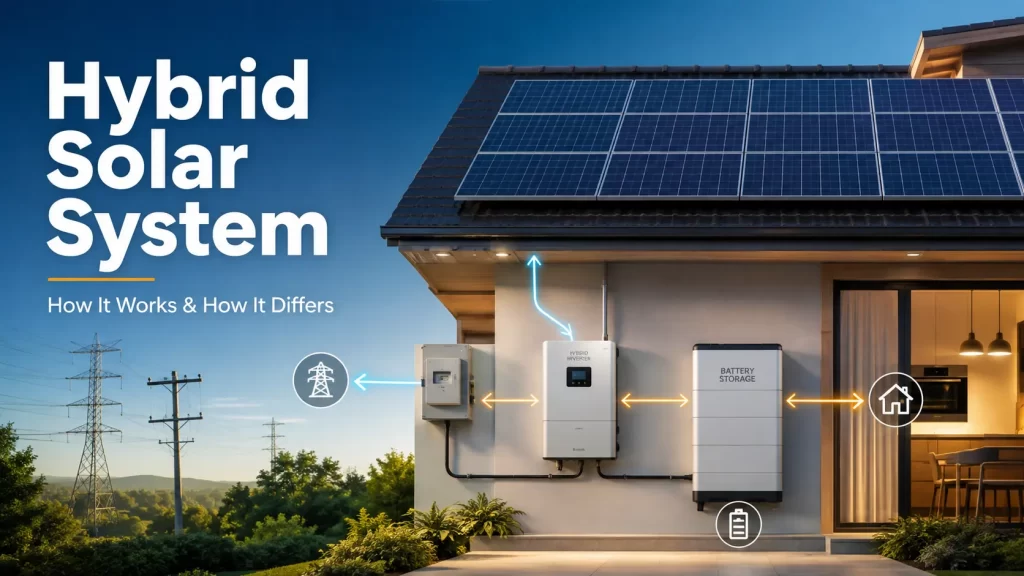
In a hybrid solar system, solar PV panels, batteries, hybrid inverter, and electricity grid are integrated to form an electricity system.
During the daytime, solar electricity can be used to power the devices. If there is a surplus of solar electricity, it can be used to charge the batteries. When there is not sufficient solar electricity, the electricity stored in the batteries can be used.
In other words, with a hybrid system, you can have different options to control your electricity usage:
- Using solar electricity directly.
- Using excess solar electricity to charge batteries.
- Later using the electricity stored in the batteries.
- Drawing electricity from the grid.
- Having battery backup for selected loads in case of blackout (if supported by the system).
A hybrid inverter controls the exchange of electricity among different sources and loads.
How Does a Hybrid Solar System Work?
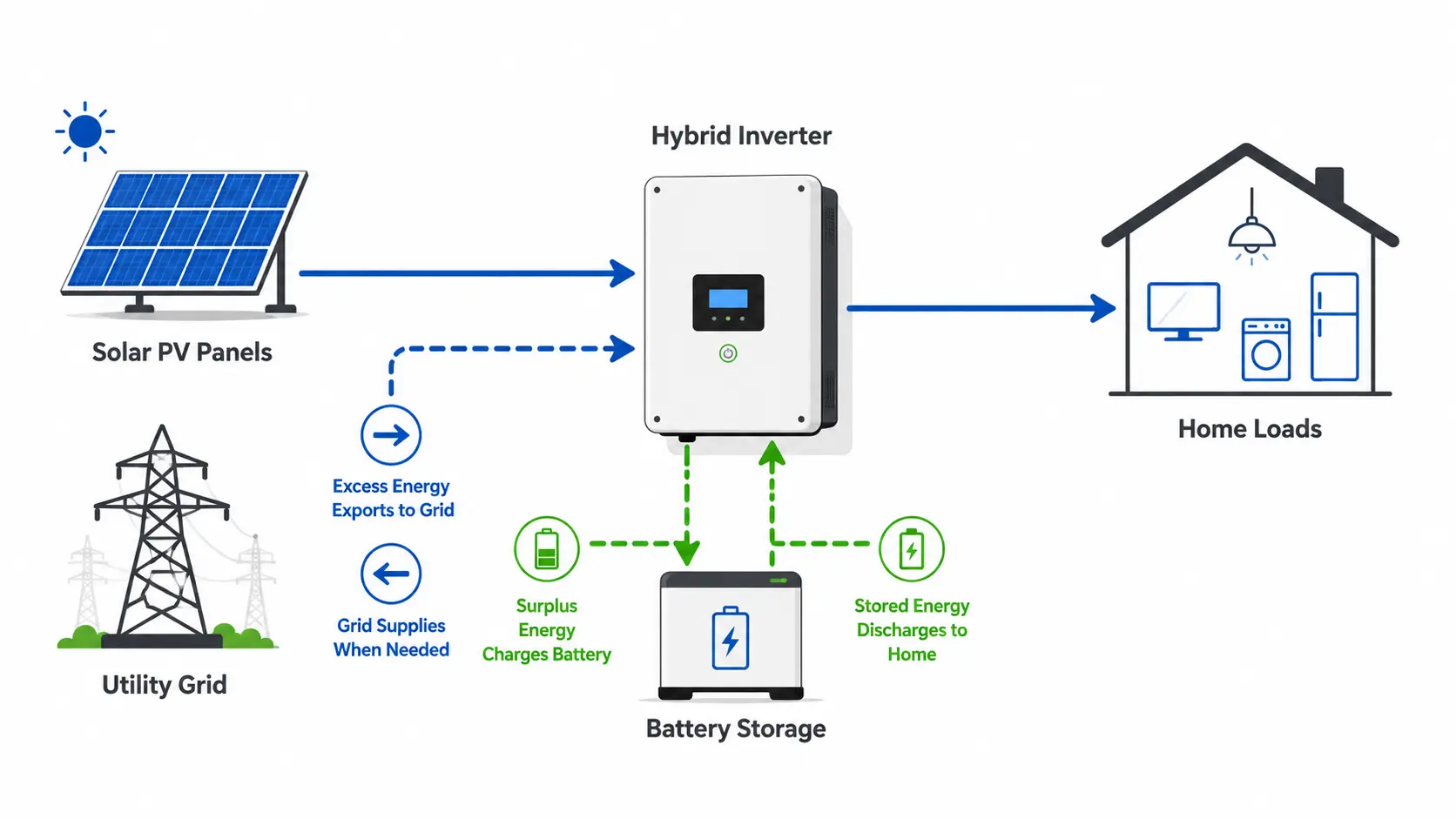
The basic power flow looks like this:
Solar PV → Hybrid Inverter → Electrical Loads
↓
Battery
↕
Utility Grid
It depends on what takes place at a certain point of time which will depend on the following factors – solar generation, demand from your home, battery status, inverter settings, and availability of the grid connection.
Solar production varies through the day highest around midday, low or zero at night. The inverter continuously balances what the panels are producing against what your home needs, using the battery and grid to fill any gap. For the full step-by-step breakdown of daytime, low-sun, and nighttime behavior, see How Does a Hybrid Solar System Work →.
During a Power Cut
One of the differences between grid-tie systems and hybrid systems that have a backup function is this.
A regular grid-tie inverter always stops when there is no power on the utility grid. A backup-capable hybrid system isolates itself from the grid instead and continues serving selected loads, such as lights, fans, refrigerators, Wi-Fi devices, and alarm systems, from the battery, provided it holds sufficient charge.
For the full backup sequence step by step, see the full backup sequence →.
What Happens to Excess Solar Energy?
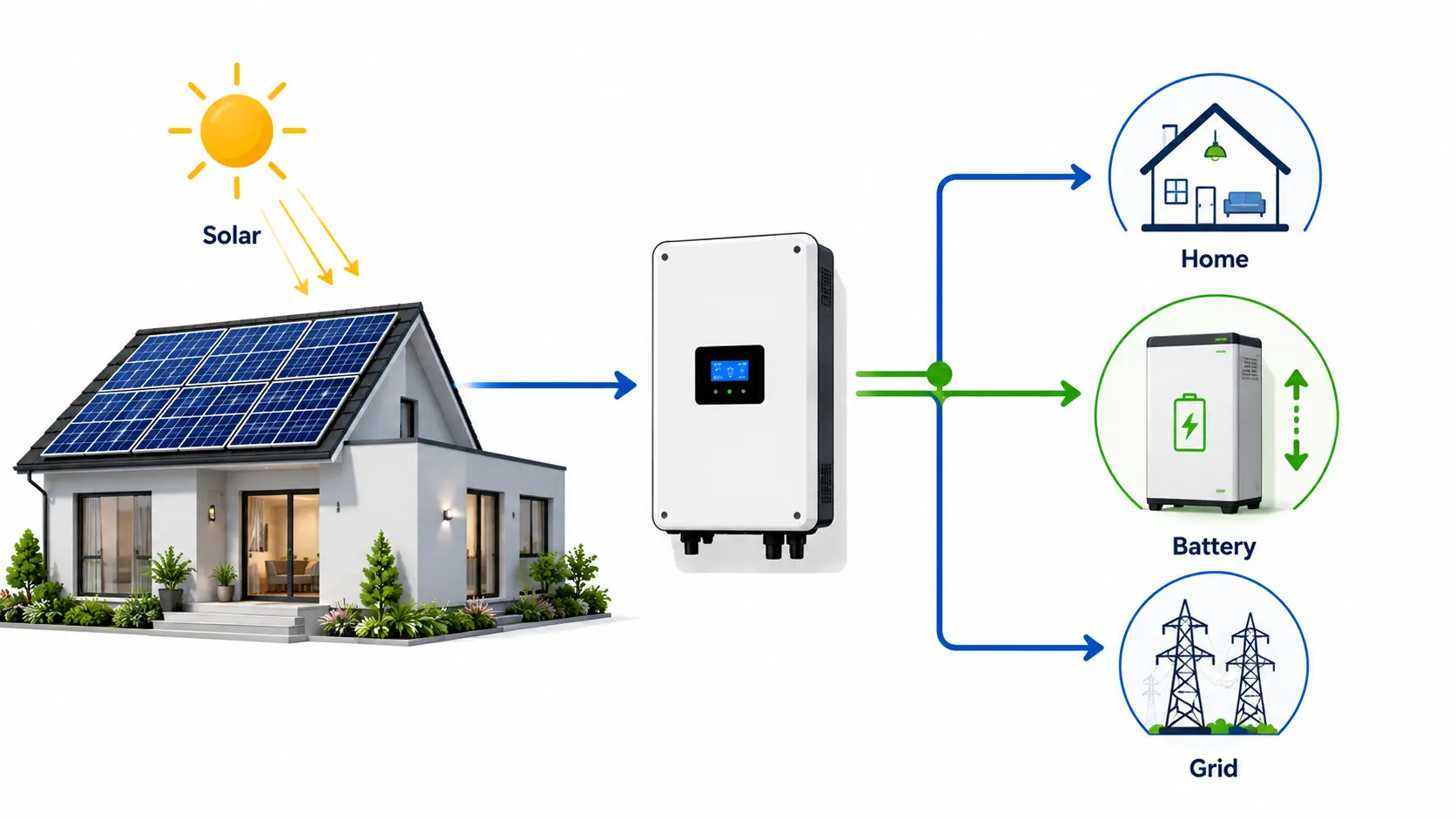
Solar generation and power consumption never quite coincide.
Your solar cells may be producing excess power when you do not need it most of the time during the day. The hybrid system is capable of handling the excess in three main ways.
1. Use Solar Power Directly
The power system is able to transfer electricity from the sun directly to your appliances.
2. Store It in the Battery
Surplus solar electricity can charge the battery for later use, depending on the capacity of the inverter and charger.
3. Export It to the Grid
In case of a full battery or grid export configuration, excess power can also be fed back into the utility grid.
The availability of export facilities is dependent on various factors such as regulation, utility requirement, metering system, and system configuration.
What Are the Main Components of a Hybrid Solar System?
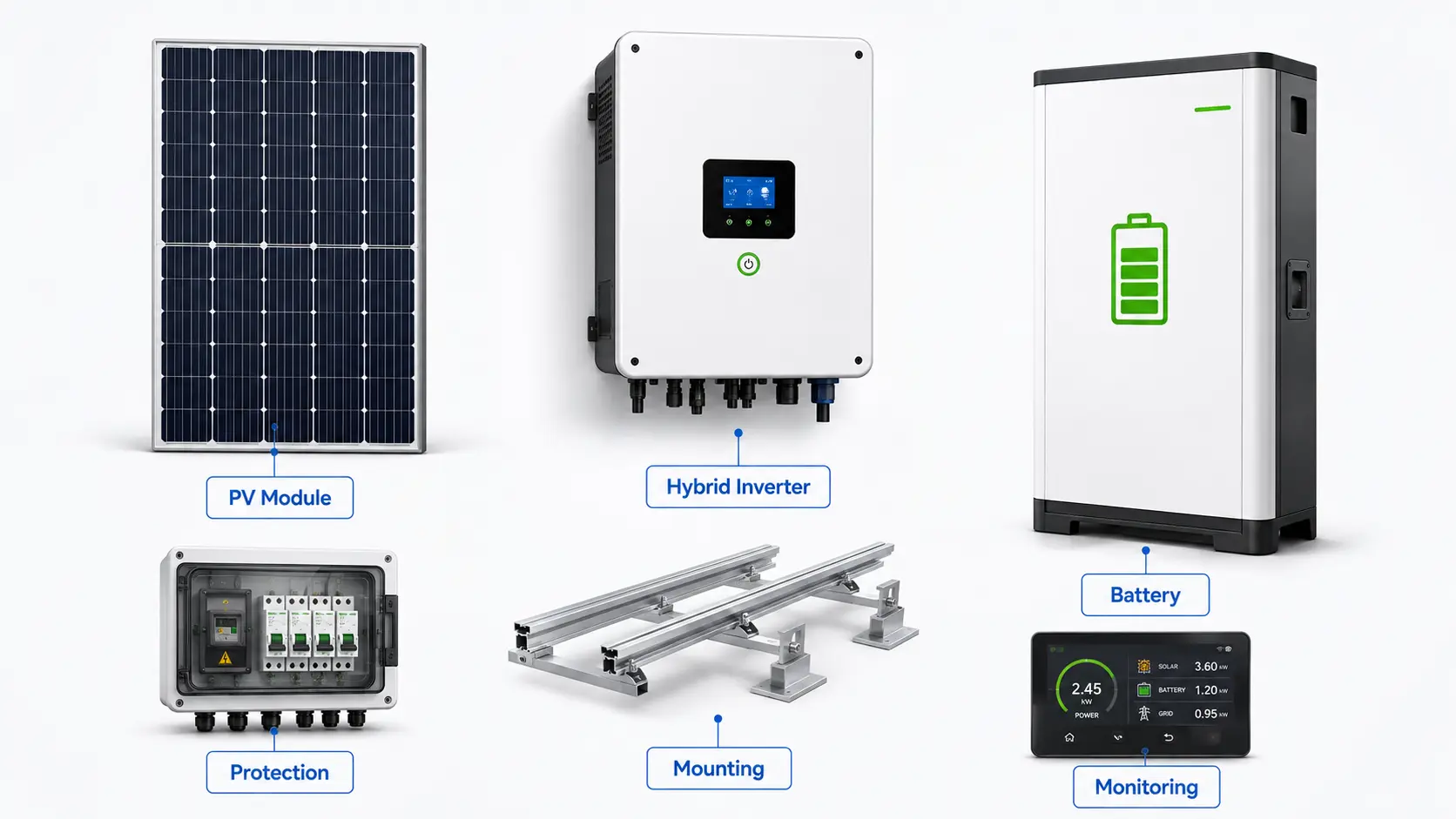
A typical hybrid setup includes several key components.
- Solar PV Modules: Convert sunlight into DC electricity. Actual output depends on weather, shading, and orientation.
- Hybrid Solar Inverter: The central control point, managing electricity flow between panels, battery, loads, and grid.
- Battery Energy Storage: Stores electricity, measured in kWh, for later use. Usable capacity is always less than rated capacity.
- Utility Grid: Supplies power when solar and battery sources cannot meet demand, and may accept exported surplus.
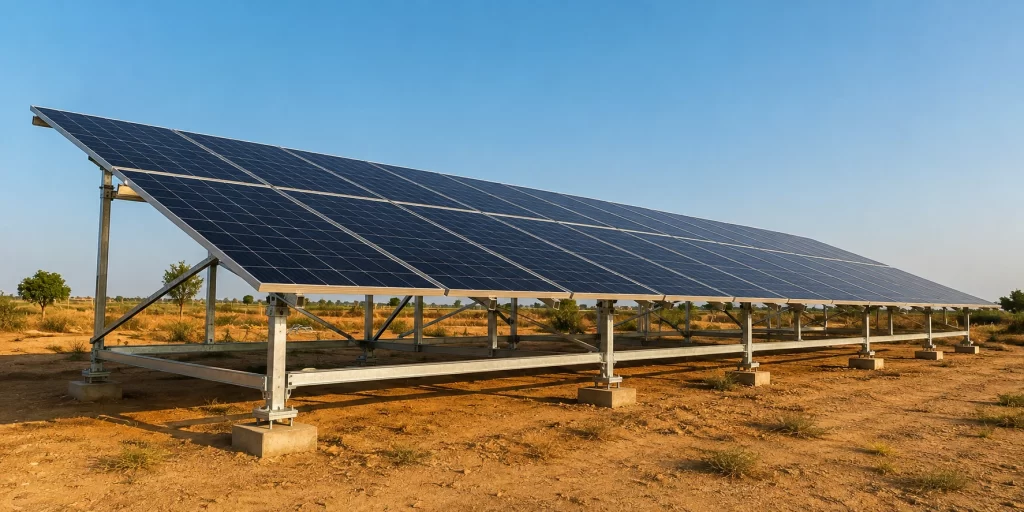
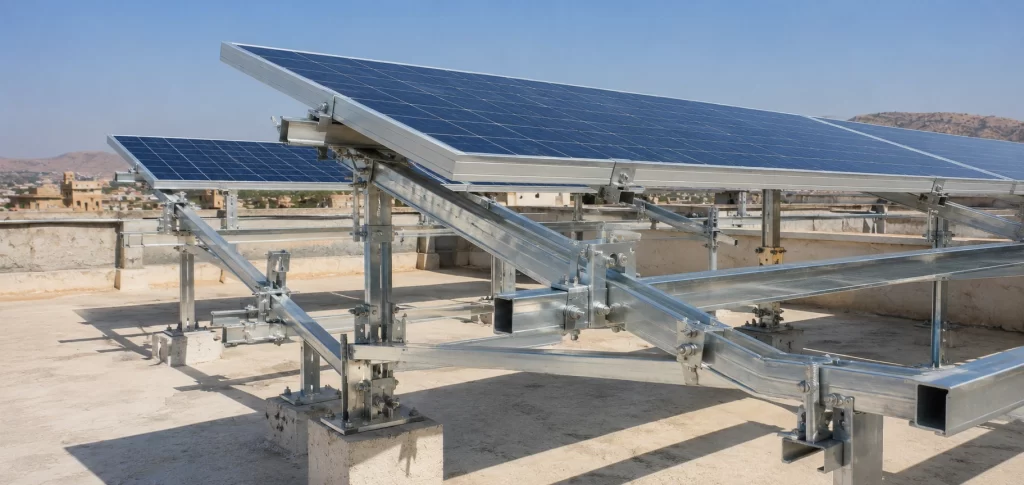
- Mounting and Protection Equipment: Includes solar mounting structure, cabling, isolators, breakers, surge protection, and earthing.
kW vs kWh: What’s the Difference?
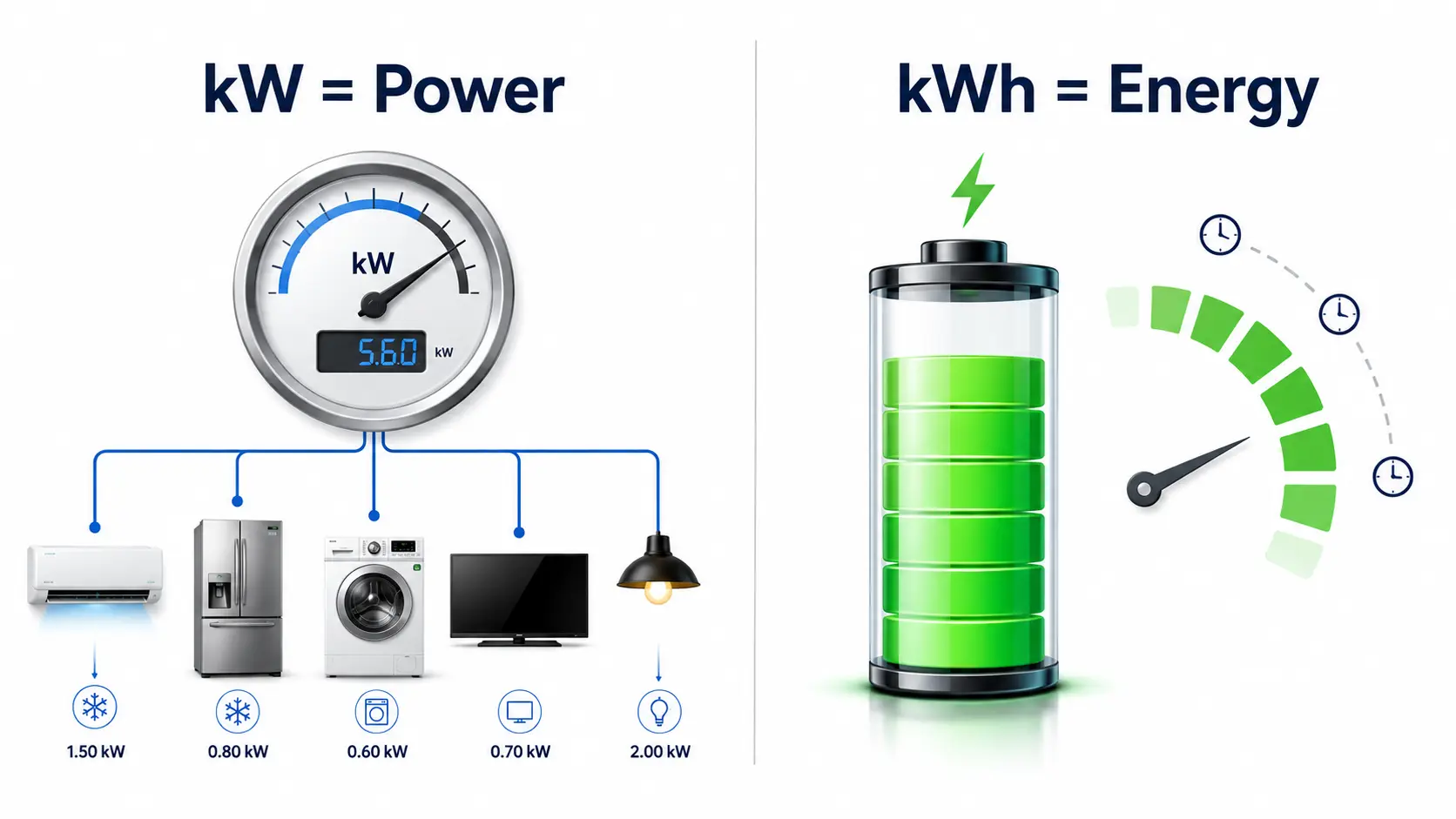
Two numbers matter when sizing a hybrid system: kW, which measures power, and kWh, which measures energy.
See our full breakdown of the difference in Hybrid Solar System Working
How Is a Hybrid Solar System Sized?
There’s no single system size that works for every property.
When determining the size of a hybrid system, consider:
- Amount of electricity used daily
- Peak power demand
- Solar resource
- Available installation area
- Battery capacity
- Required time to provide backup
- Critical loads
- Future electricity needs
Solar Capacity
A basic estimate for daily solar generation is:
PV energy ≈ PV capacity × peak-sun hours × system performance factor
For example:
5 kW × 5 hours × 0.8 = 20 kWh/day
This is just an estimation. The actual output will be affected by location, climate, shading, orientation, temperature, and the systems involved.
Battery Capacity
Battery sizing depends on the loads you want to back up and how long you need them to run.
For example:
1.5 kW backup load × 6 hours = 9 kWh
That’s an energy consumption of 9 kWh. In fact, the actual size of the battery could have to be bigger after taking into consideration the usable capacity and other factors.
Inverter Capacity
The inverter must be able to cater for the highest load that could ever be connected at one time.
Even though an average home consumes 2 kW of power, it would need a larger inverter if the above appliances work together at one go.
The other equipment includes air conditioners, pumps, refrigerators, and other motor driven appliances
Hybrid vs On-Grid vs Off-Grid Solar Systems
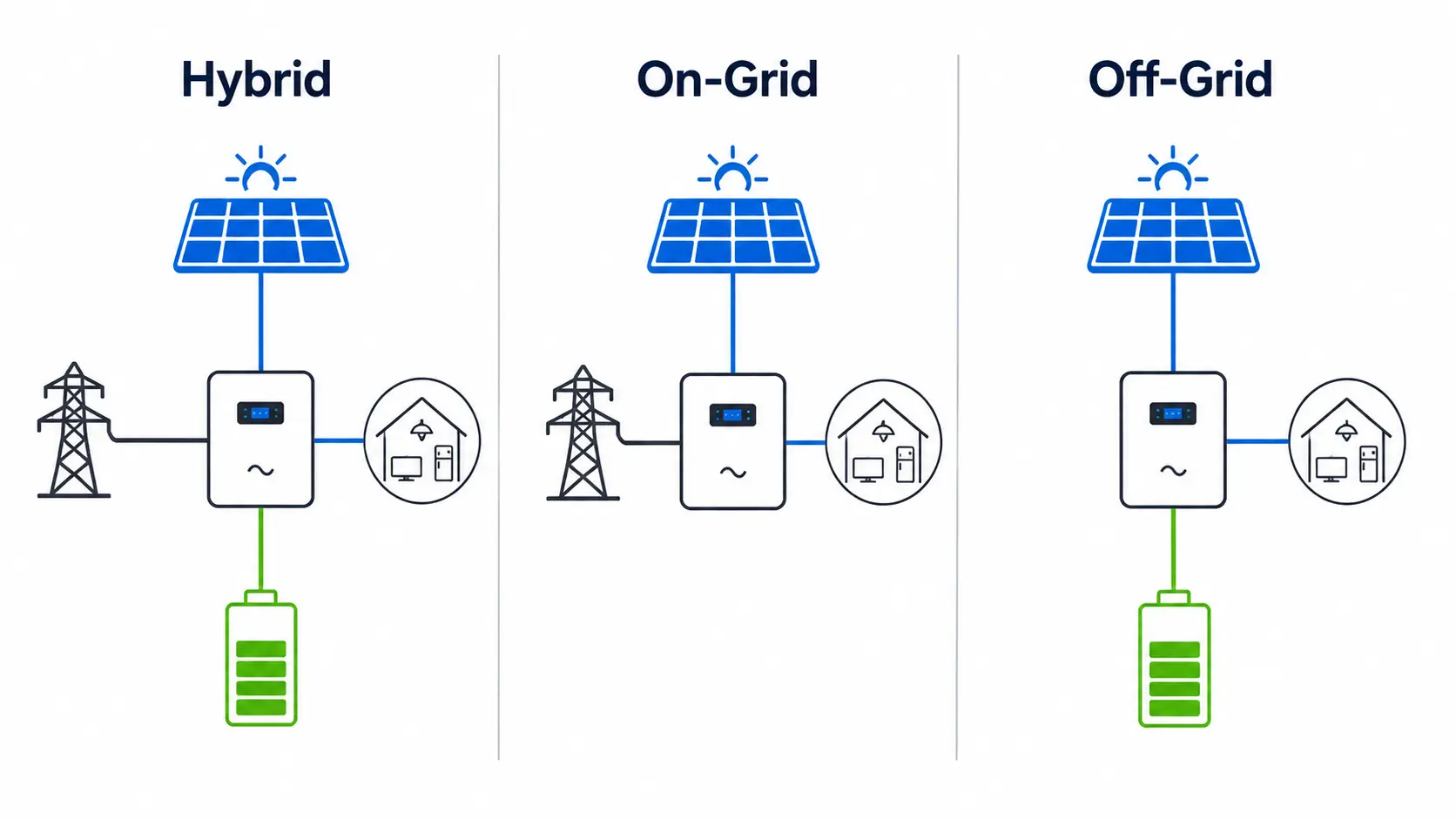
The easiest way to understand the difference is to look at how each system handles solar energy, batteries, the grid, and outages.
| Feature | Hybrid | On-Grid | Off-Grid |
| Solar PV | ✓ | ✓ | ✓ |
| Battery storage | ✓ | Optional | ✓ |
| Utility grid | ✓ | ✓ | ✗ |
| Backup during outage | ✓* | Usually no | ✓ |
| Stores solar energy | ✓ | Usually no | ✓ |
| Grid export | Depends on configuration | Usually possible | ✗ |
| Grid dependence | Low–moderate | High | None |
*Backup requires a suitable inverter, battery, and correctly designed backup circuits.
Hybrid Solar System
This system consists of a combination of solar power, battery, and grid. This is ideal for properties that need solar power, while still maintaining grid and battery backup.
On-Grid Solar System
An on-grid system connects the PV array to the utility grid. It can reduce grid electricity consumption but normally doesn’t provide backup power during an outage.
Off-Grid Solar System
An off-grid system operates independently of the utility grid. It relies on solar generation, battery storage, and potentially another backup source such as a generator.
Hybrid Solar System for Home
Such a solar power system would be helpful for houses that wish to integrate roof solar power with battery storage and grid connection. For information on India’s residential rooftop solar programme, see the official PM Surya Ghar portal.
Before choosing a system, consider:
- Daily power usage
- Max demand
- Available rooftop space
- Shading
- Critical load
- Desired backup duration
- Battery capacity
- Inverter capacity
- Future energy requirements
A large battery may not be required if its purpose is to charge the home’s entire daily energy consumption.
This is because if the battery is for backup purposes only, one should consider essential appliances and how long they will run.
What Are the Advantages and Limitations?
A hybrid system is more flexible than a grid-tied solar power system, but at the same time requires more components and expense.
Advantages
Use more solar energy: Use your extra solar energy and save it for later use rather than just using it when it is being generated.
Backup Energy: Properly designed systems will maintain some loads even when there is no electricity from the grid.
Grid Dependence Reduction: Batteries help reduce the grid electricity usage.
Energy Management: Proper management of the solar, batteries, and grid electricity depending upon the configuration.
Better utilization of extra electricity generation: Extra electricity can be saved for later use.
Limitations
Higher installation costs: Batteries and hybrid inverters are more expensive in the beginning.
Degradation of batteries: The capacity of batteries degrades with time and usage.
Less backup power: Batteries have a limited amount of backup power they can provide.
More complex installation process: All components must function properly in coordination.
Sizing is crucial: An undersized inverter or battery may fail to deliver the required output.
Is a Hybrid Solar System Right for You?
Consider using a hybrid system when you:
- Have frequent blackouts
- Require back up power for vital loads
- Want to store extra solar power
- Consume power after dark hours
- Wish to decrease dependency on the grid
- Have sufficient space for installing solar panels and batteries
Having solar does not automatically require hybrid system technology.
If the grid works efficiently and all that you want is to reduce consumption of electricity, then an on-grid system may work for you. However, if you need backup, a hybrid system is useful since you can store some solar energy.
Before choosing, focus on four numbers:
Daily consumption → kWh/day
Maximum demand → kW
Backup requirement → hours
Solar capacity → kW/kWp
Those figures give you a much better starting point than choosing a system based only on the number of panels.
Frequently Asked Questions
What is a hybrid solar system in simple words?
A hybrid solar system comprises solar panels, battery storage, hybrid inverter, and the grid. It allows direct usage of solar energy, stores surplus electricity and utilises battery/grid power when the solar production is insufficient.
Can a hybrid solar system send electricity to the grid?
Yes, a grid-tied hybrid system is able to export surplus solar power as long as the inverter, meter, and utilities permit.
How long can a hybrid solar system provide backup?
Back-up period is determined primarily by battery capacity and load requirements.
Assuming 8 kWh battery with 1 kW load, it will yield the following back-up period in theory:
8 kWh ÷ 1 kW = 8 hours
However, the actual back-up period will vary since there are changes in household loads and losses.
Is a hybrid solar system better than an on-grid system?
It will depend on your requirements.
The hybrid system is preferable if you require energy storage along with backup. The grid tie system would be better if your prime requirement is to produce solar energy and minimize grid dependency.
What is a hybrid solar inverter?
The hybrid solar inverter controls power flow from the solar panel system, batteries, grid, and loads. Depending on the kind of hybrid solar inverter used, it can control various functionalities like battery charge and discharge, grid interaction, and monitoring.
What is the difference between a hybrid and off-grid solar system?
The hybrid system is still grid-connected and uses energy from the grid if needed. The off-grid system runs separately from the grid and utilizes its own sources of power from the sun and battery energy.
Wrap Up
A hybrid solar system gives you solar power, battery storage, and grid support in one setup. The right system isn’t the biggest one, it’s the one sized around what your property actually generates and uses.