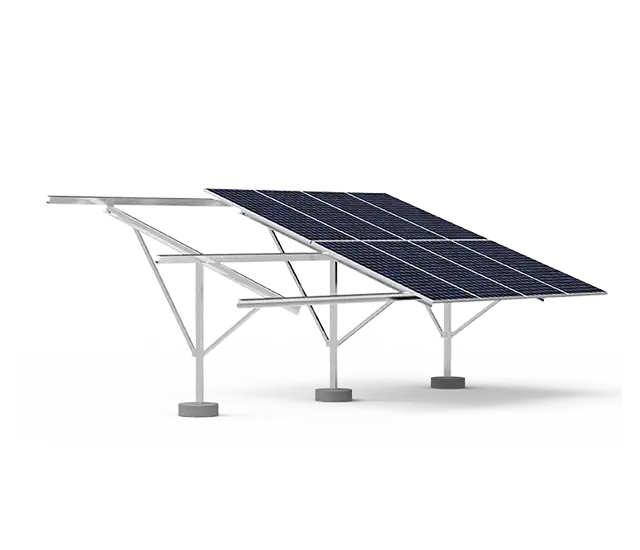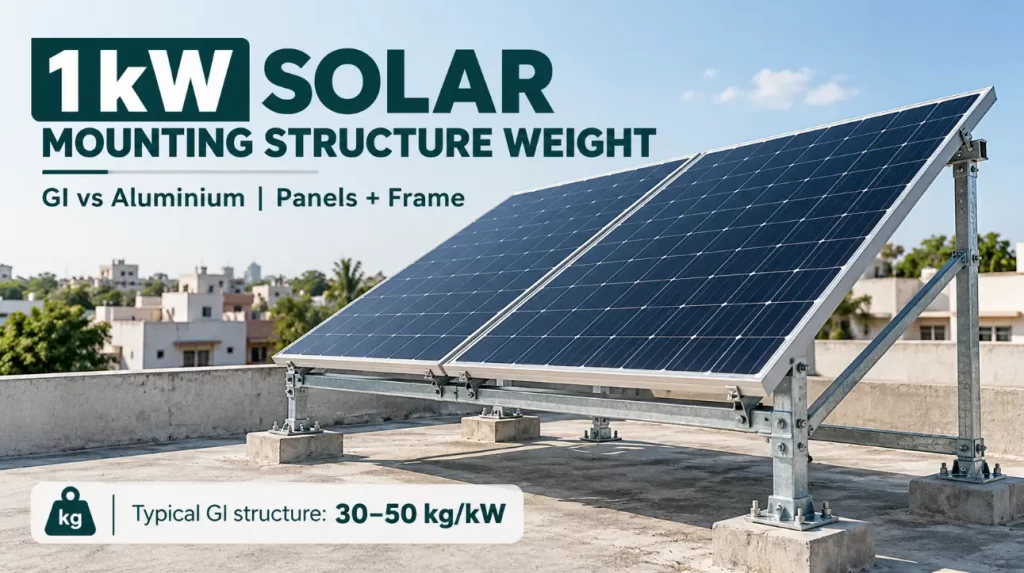
Quick answer: A 1 kW solar mounting structure weighs about 30 to 50 kg in hot-dip galvanised (GI) steel. Aluminium weighs about 15 to 25 kg. Two 550 Wp panels add 56 to 63 kg. So a complete 1 kW system weighs about 85 to 105 kg with GI, or roughly 1.5 to 1.9 kg per sq ft of roof.
Why do weights online disagree?
One page says 10 kg per kW, and the next says 50 kg. Both can be right for different setups. Three things cause the gap.
- Panel wattage: a 550 Wp panel needs less frame per kW than a 335 Wp panel.
- Structure type: GI, aluminium and low-tilt frames weigh differently.
- Missing context: many pages skip the panel size and steel thickness.
So the better question is “what does it weigh for my panels and my frame?” The sections below show you how to work that out.
Weight of a 1 kW solar system
Two 550 Wp panels make 1.1 kW, which is the closest you can get to 1 kW today.
| Part | GI structure | Aluminium structure |
| Two 550 Wp panels (glass-backsheet) | 56 kg | 56 kg |
| Structure | 30 to 50 kg | 15 to 25 kg |
| Total | 85 to 105 kg | 70 to 80 kg |
Dual-glass panels add about 7 kg to each total. Inverters and batteries cost extra weight too. Our guide to hybrid solar system components covers those parts.
How much does a 550 watt solar panel weigh in kg?
Glass type decides the weight. Adani’s module datasheets list these figures for 550 Wp panels.
| Panel type | Size (mm) | Weight | kg per kW | kg per sq ft |
| Glass-backsheet | 2278 × 1133 | 28 kg | about 51 | about 1.0 |
| Dual glass | 2278 × 1133 | 31.3 kg | about 57 | about 1.1 |
Dual glass adds 6 to 7 kg per kW. Always check the datasheet for your exact model.
Solar panel sizes and wattage
A 550 Wp panel measures about 7.5 ft × 3.7 ft and covers about 27.8 sq ft. Higher-wattage panels mean fewer panels per kW. As a result, you need less structure.
| Panel wattage | Panels for about 1 kW | Panels for about 3 kW | Panels for about 5 kW |
| 335 Wp | 3 | 9 | 15 |
| 440 Wp | 2 | 7 | 11 |
| 550 Wp | 2 | 6 | 9 |
These counts use the closest whole number of panels. Panel size grows with wattage, so check the datasheet for exact dimensions.
How much does a solar mounting structure weigh per kW?
Here is the formula most pages skip.
Structure weight per kW = structure weight ÷ system kW
For example, a 77 kg structure holds four 550 W panels, which is 2.2 kW. So it weighs 35 kg per kW. Published figures for GI range from about 20 to 56 kg per kW. Most land between 30 and 50.
| Structure type | Typical weight per kW |
| GI elevated | 30 to 50 kg |
| GI low-tilt | 20 to 30 kg |
| Aluminium rail | 15 to 25 kg |
These are typical ranges, not fixed values. Ballast and ground-mount systems usually weigh more because of concrete blocks or foundations. That depends on the site, so we don’t quote a range.
Four things move the number the most:
- Steel thickness: thicker C-channel adds weight and strength.
- Leg height: taller legs need heavier bracing.
- Wind-speed design: windy zones need stronger frames.
- Tilt: a steeper tilt needs a taller frame. Our guide on solar panel direction and angle in India explains the right tilt.
Weight of a 3 kW system and other sizes
This table uses 550 Wp glass-backsheet panels and a GI elevated structure at 35 kg per kW. The kW values are the real panel totals.
| System | Panels | Panel weight | Structure | Total | Array area |
| 1 kW | 2 (1.1 kW) | 56 kg | 39 kg | 95 kg | 56 sq ft |
| 2 kW | 4 (2.2 kW) | 112 kg | 77 kg | 189 kg | 111 sq ft |
| 3 kW | 6 (3.3 kW) | 168 kg | 116 kg | 284 kg | 167 sq ft |
| 5 kW | 9 (4.95 kW) | 252 kg | 173 kg | 425 kg | 250 sq ft |
| 10 kW | 18 (9.9 kW) | 504 kg | 347 kg | 851 kg | 500 sq ft |
Take the 3 kW row. Six panels in two rows of three take about 11 ft × 15 ft. However, you need 250 to 300 sq ft of shadow-free roof. The extra space covers walkways and the gap between rows. Our hybrid solar system sizing guide shows how to pick the right size.
Every row works out to about 1.7 kg per sq ft, or 18 kg per m². That is your dead load, and it stays steady as the system grows.
Can your roof take the weight?
Usually, but check three things.
- Dead load: the fixed weight of panels and frame, about 1.7 kg per sq ft above.
- Live load: people walk on the roof for cleaning and repairs.
- Wind uplift: wind pulls the array up. In windy states like Rajasthan and Gujarat, this often matters more than weight.
So a lighter frame is not always better. A frame that is too light can lift in a storm. Building loads in India follow IS 875, available through the Bureau of Indian Standards. If your roof is old or cracked, ask a structural engineer to check it first.
FAQs
How much does a 1 kW solar panel typically weigh?
No single 1 kW panel exists. You use two 550 Wp panels, which weigh 56 to 63 kg together.
How much does a 550 watt solar panel weigh in kg?
About 28 kg for glass-backsheet and 31.3 kg for dual glass.
What is the 3 kW solar panel weight in kg?
Six 550 Wp panels weigh about 168 kg, or 188 kg with dual glass.
What is the 3 kW solar panel size in feet?
Six panels in two rows of three cover about 11 ft × 15 ft, or 167 sq ft. Plan for 250 to 300 sq ft of shadow-free roof.
What is the weight of solar panels per square foot?
About 1.0 to 1.1 kg per sq ft for the panel alone. With a GI structure, the whole array is about 1.7 kg per sq ft.
Is aluminium better than GI?
Aluminium is lighter and resists rust. GI is usually cheaper, so it is more common on rooftops. Our guide on on-grid vs off-grid vs hybrid solar systems helps you choose the system first.
Does a heavier structure mean a better one?
No. Steel thickness, galvanising quality and design matter more than weight alone.
Need more info?
Weights change with design, wind zone and panel size. If you need an exact figure for your roof, talk to our team. Find us on Google Maps and get in touch.