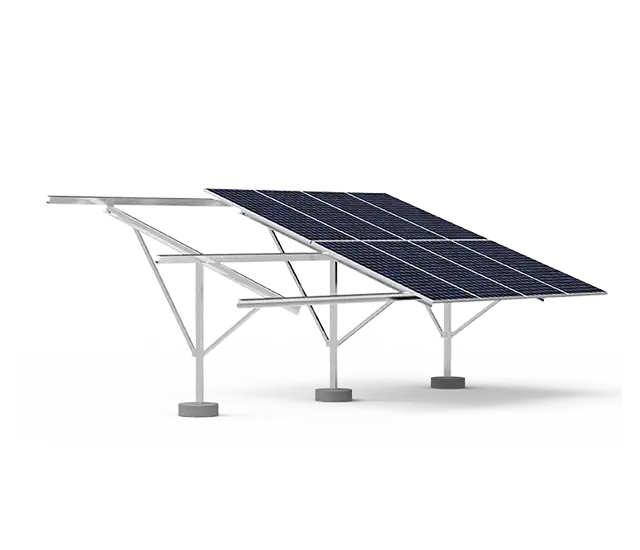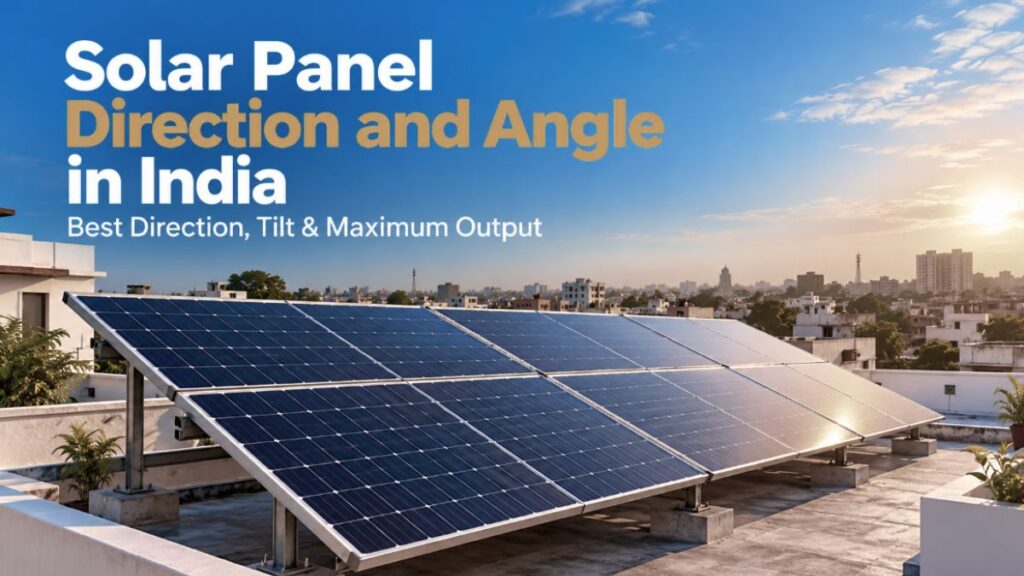
Quick answer: In India, face your solar panels true south and set the tilt close to your city’s latitude, but never below 10 to 15° so rain can clean them. Small errors cost little, so a south-east or south-west roof still works well. East-west layouts lose some yield but suit shaded roofs or evening-heavy homes. Avoid north-facing roofs, which lose the most output.
Why do solar panels face south in India?
India lies in the Northern Hemisphere, so the sun sits in the southern half of the sky for most of the year. A south-facing panel sees the sun from morning to evening and gets the strongest light around solar noon. That’s why true south, which is 180° on a compass, gives the highest yearly output.
True south isn’t the same as magnetic south, which is where a compass needle points. The gap in India is small, but it’s worth correcting. Also, in far southern cities like Chennai, the sun passes almost overhead for part of the year, so a small direction error matters even less.
Best tilt angle for solar panels in India
For a fixed system, set the tilt close to your latitude. Delhi sits near 28.6°N, so a tilt of 25 to 30° works. Chennai sits near 13°N, so 10 to 15° works. The logic is simple. The further north you go, the lower the winter sun sits, so the panels need to be steeper.
Two limits apply. First, don’t go below about 10 to 15°, even in the far south, because rain can’t wash dust off flatter panels. Second, you don’t need the exact number. In a US Department of Energy example cited by EnergySage, a roof tilted at 18° instead of the 30° ideal lost only about 2% of its yearly output. A lower tilt also needs less row spacing on a small roof.
Fixed or seasonal tilt?
Adjustable structures let you change the angle twice a year: latitude minus 15° from April to September, and latitude plus 15° from October to March. So if you have one, October is when you switch to the winter setting. The gain is modest.
An analysis of NASA POWER data found about 3 to 5% more yearly energy, while some Indian sites claim 10 to 15%.
Solar panel tilt angle by city
Use this table as a starting point. Fixed tilt is roughly the city’s latitude. The summer and winter columns apply only to adjustable structures, and the summer value stops at 10° so rain can still clean the panels.
| City | Latitude (°N) | Fixed tilt | Summer (Apr to Sep) | Winter (Oct to Mar) |
| Srinagar | 34.1 | 34° | 19° | 49° |
| Chandigarh | 30.7 | 31° | 16° | 46° |
| Sri Ganganagar | 29.9 | 30° | 15° | 45° |
| Delhi | 28.6 | 29° | 14° | 44° |
| Jaipur | 26.9 | 27° | 12° | 42° |
| Lucknow | 26.8 | 27° | 12° | 42° |
| Ahmedabad | 23.0 | 23° | 10° | 38° |
| Kolkata | 22.6 | 23° | 10° | 38° |
| Nagpur | 21.1 | 21° | 10° | 36° |
| Mumbai | 19.1 | 19° | 10° | 34° |
| Pune | 18.5 | 19° | 10° | 34° |
| Hyderabad | 17.4 | 17° | 10° | 32° |
| Bengaluru | 13.0 | 13° | 10° | 28° |
| Chennai | 13.1 | 13° | 10° | 28° |
| Thiruvananthapuram | 8.5 | 10° (minimum) | 10° | 24° |
These are rule-of-thumb values. For your exact site, the free Global Solar Atlas shows the optimum tilt for any location in India.
What a wrong direction or angle costs
Sources disagree on these figures, and the loss depends on latitude, tilt and shading. Treat the ranges as ballpark numbers.
| Setup | Typical yearly loss vs true south |
| South-east or south-west | Around 5% |
| East or west | About 5 to 20%, depending on the source |
| East and west split | About 10 to 20% |
| North-facing | About 25 to 40% |
East or west panels usually lose less in the far south, where the sun passes close to overhead, and more in the north, where the winter sun sits low. Estimates for a small direction error also vary, from under 1% for 10° off (US Department of Energy data) to 5 to 10% for 15° off (one Indian calculator).
So aim for the true south, but don’t worry about a few degrees. For exact numbers on your roof, ask for a site simulation in PVsyst or HelioScope.
East, west or south: which should you choose?
South wins on yearly output, but it isn’t always the right call. Pick by your roof and your usage.
| Your situation | Best choice | Why |
| Clear south side, no shade | South | Highest yearly output |
| South side shaded or blocked | East-west, or the clear side | A clear east or west beats a shaded south |
| Most power used in the evening | West-leaning | Output shifts later in the day |
| Most power used in the morning | East-leaning | Output shifts earlier |
| Business on time-of-day tariffs | Match the peak tariff window | Output lines up with costly hours |
| Small flat roof, need more panels | East-west at low tilt | Low tilt needs less row spacing |
| Only a north-facing roof | Another roof section or a ground mount | Losses are the highest |
A south-facing system peaks around noon, while an east-west system gives a flatter, broader curve from sunrise to sunset. East and west produce similar yearly totals, so choose by when you use power.
Flat roof or sloped roof?
Flat RCC roof : Many Indian homes have one, and it gives you full control. The mounting structure sets the tilt and direction, so you can aim for true south and a tilt near your latitude. The trade-off is space, because a steeper tilt needs more room between rows to avoid shading.
For example, take a 2 m panel in Delhi. Row pitch equals panel length × cos(tilt) plus panel length × sin(tilt) ÷ tan(sun height).
At noon on 21 December, the sun stands about 38° high in Delhi. That gives a pitch of about 2.6 m at a 15° tilt and about 3.0 m at 29°. So the steeper tilt needs roughly 15% more roof depth per row. Designers often plan for a longer shade-free window than noon, which adds more space.
Sloped roof: Panels usually sit parallel to the roof, so the roof pitch sets the tilt. Because small tilt errors cost little, that’s usually fine if the slope faces south, south-east or south-west. If it faces north, look for another roof section or a ground mount. Our guide to hybrid solar system components explains how mounting structures fit in.
How to find true south
- Use a compass app that shows true north, or lets you set magnetic declination. If yours shows only magnetic north, look up your city’s declination and correct for it.
- Check with a shadow. At noon, a vertical stick’s shadow lies along the north-south line. In southern cities in summer, the sun can pass north of overhead, so the shadow may point south, but the line is still right.
- Don’t use 12:00 on your watch for noon. India has one time zone, so solar noon comes later in the west, in places like Rajasthan and Gujarat, than in the east. A free solar noon calculator gives your city’s time.
- Mark the line on the roof with chalk or string before the structure goes up.
Shading, dust and where not to place panels
Avoid these spots and problems:
- Shade: Parapet walls, water tanks, staircase rooms, trees and nearby buildings. Aim for no shadows between about 9 am and 4 pm.
- North-facing slopes: They lose the most output.
- Spots you can’t reach: Panels you can’t get to won’t get cleaned.
- Almost flat mounting: Dust and water sit on the glass instead of running off.
Dust matters most in dry, dusty regions such as Rajasthan, Punjab and Haryana. Keep the tilt at 10 to 15° or more, and plan regular cleaning.
FAQ
Why do solar panels face south in India?
India lies in the Northern Hemisphere, so the sun sits mostly in the southern half of the sky. Facing south keeps panels in direct light for most of the day.
Which is better for solar panels, east or west-facing or south-facing?
The South gives the highest yearly output. Choose east or west only when the south side is shaded, or when you use most power in the morning or evening.
Is it better to have solar panels facing north or south
South. North-facing panels lose about 25 to 40% of their output in India, so avoid them.
Where should you not place solar panels?
Avoid shaded areas, north-facing slopes and spots you can’t reach for cleaning. Also avoid mounting panels almost flat, because dust won’t wash off.
What is the 20 rule for solar panels?
It’s a sizing rule, not an angle rule. It suggests designing the system to produce about 20% more than your average use. See our guide to sizing a hybrid solar system.
Do direction and tilt change panel efficiency?
No. They change how much energy the panels produce, not their rated efficiency.
Does Vastu change the best direction?
Some Vastu guidance favours the south-east. A south-east roof typically loses only a few percent of yearly output, so following it costs little.