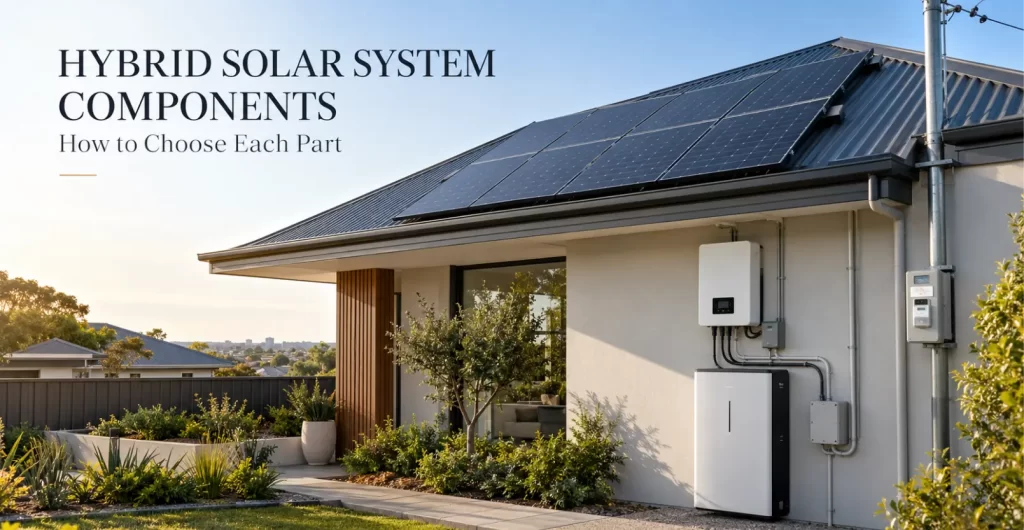
A hybrid solar system has four main parts. These are solar panels, a hybrid inverter, a solar battery, and a utility grid connection. Get any one of these wrong and the rest of your solar power system pays for it.
This guide skips the basics of solar energy and gets straight into how to actually choose each component. Understanding the components of a hybrid solar system now saves you money and headaches later. Want the bigger picture first? Check our Hybrid Solar System guide.
Key Takeaways
- The hybrid inverter is the real decision maker. Its continuous rating (not surge rating) decides what your system can actually handle.
- Lithium batteries dominate new installs because they give more usable capacity and last longer than lead-acid.
- Panel wattage, inverter capacity, and battery voltage all need to match up. Mismatched specs cause underperformance, not just inconvenience.
- A 1kW system needs the same four components as a 5kW one. Only the sizing changes.
Core Components of a Hybrid Solar System
Every hybrid setup needs four parts. A hybrid inverter is one part. Solar panels are another.
A solar battery is another. A grid connection is the last part. Here’s how to choose each one, starting with the part that controls the rest.
The hybrid inverter controls everything. It converts DC power from your panels into AC power your appliances can use. It also manages power flow between the panels, battery, home, and grid. Of all the components of a hybrid solar system, this one deserves the most attention on your shopping list.
Continuous Rating vs Surge Rating
Every hybrid inverter lists two power numbers:
- Continuous rating: what it can supply nonstop.
- Surge rating: a higher number it can handle for a short time.
- People often use it to start a motor-driven appliance, like a pump or AC unit.
Buy based on the continuous rating, not the surge rating. A 5kW hybrid solar inverter may list a 5kW surge rating, but only 3.5kW continuous. It can struggle under a sustained load, even if the label looks impressive.
MPPT Channels
MPPT stands for Maximum Power Point Tracking. It’s how the inverter pulls the most power out of your panels. More MPPT channels let you wire panel groups facing different directions on their own. This helps if your roof is not one flat surface.
Battery Compatibility
Not every battery works with every inverter. Before you buy either one, check:
- Matching voltage between inverter and battery
- Supported communication protocol (usually CAN bus or RS485)
- Manufacturer-approved battery pairings, since using an unapproved battery can void your warranty
Solar Panels: Wattage, Size, and Space
Panels generate DC power from sunlight, and this DC electricity then heads to the inverter for conversion. Panel choice comes down to three things: wattage, physical size, and how much roof space you actually have.
Solar Panel Sizes and Wattage
Panels commonly range from around 350W to 550W+. Higher wattage means fewer panels for the same total capacity.
Hitting 5kW takes:
- 10 panels at 500W each, or
- 14 panels at roughly 355W each
Fewer panels mean less mounting hardware and cabling, but bigger panels occupy more roof area per unit.
1kW Solar Panel Area Required
A single 500W panel needs roughly 2 to 2.2 square meters. For 1kW, you’re looking at about 6 to 7 square meters of shadow-free roof space, depending on the panel model you choose. Always check for shading from nearby trees or buildings before finalizing your layout. Shade on even one panel can drag down output for the whole string.
Panel Type
- Monocrystalline: high efficiency, better low-light performance, higher price.
- Polycrystalline: slightly less efficient, lower price, needs more space for the same output.
Most rooftop setups with limited space go monocrystalline. If space isn’t tight, polycrystalline can save you money.
Battery Storage: Lithium vs Lead-Acid
Your solar battery is often the biggest cost after the inverter. Battery chemistry matters more than most buyers think. Your panels send extra energy to charge the battery first. Then they send the rest to backup power or the grid.
| Factor | Lithium (LiFePO4) | Lead-Acid |
| Usable depth of discharge | 80 to 100% | Around 50% |
| Cycle life | 3,000 to 6,000+ cycles | 300 to 1,200 cycles |
| Size for same usable capacity | Smaller | Larger |
| Upfront cost | Higher | Lower |
| Maintenance | Minimal | Periodic |
Lithium wins on usable capacity and lifespan, which usually offsets the higher price over the system’s life. Lead-acid still makes sense if upfront budget is the tightest constraint.
Rated Capacity vs Usable Capacity
These aren’t the same number. A 10kWh lithium battery at 90% depth of discharge gives you about 9kWh usable. A 10kWh lead-acid battery, capped at 50% depth of discharge to protect its lifespan, only gives you about 5kWh usable. Two batteries, same rated size, dramatically different real-world backup time.
Battery Sizing for Hybrid Solar System
Work backward from your backup load. Say you want to run a 1.5kW critical load for 6 hours:
1.5kW × 6 hours = 9kWh
That’s your minimum usable capacity target. Build in extra margin, since real-world losses eat into that number.
Making Sure Everything Actually Works Together
A great inverter with an incompatible battery, or panels that exceed its input limits, will underperform.
This is true no matter how good each part looks on paper.
Check these before you buy:
- Panel string voltage falls inside the inverter’s accepted input range
- Total panel capacity doesn’t exceed the inverter’s max PV input
- Battery voltage matches what the inverter supports
- Battery’s communication protocol is one the inverter actually reads
- Inverter’s continuous rating covers your real running load, not just the surge number
What You Need for a 1kW Hybrid Solar System
Smaller system, same four components, just scaled down:
- 2 to 3 panels (350W to 500W each)
- A 1kW to 2kW hybrid inverter
- A small lithium battery, sized to your backup needs (2 to 3kWh is common for light loads)
- Basic mounting, isolators, and a circuit breaker sized to the setup
A 1kW system won’t run a whole house, but it comfortably covers lights, fans, and a Wi-Fi router during an outage.
Mounting and Protection Equipment
These parts don’t generate or store power, but skip them and you’re risking the system’s safety and lifespan.
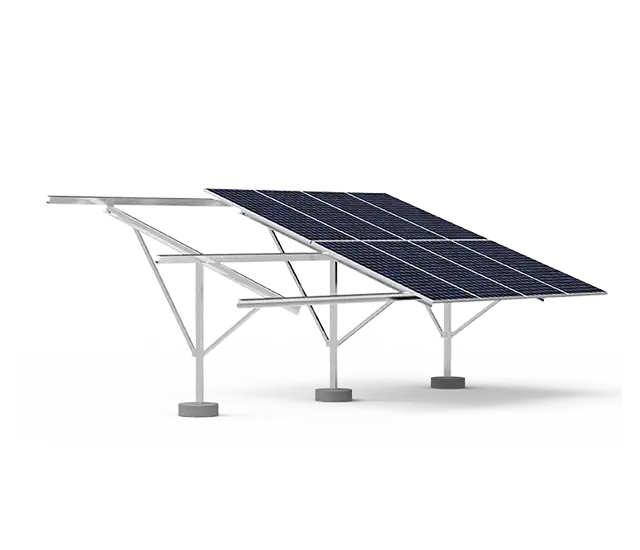
- Mounting structure: roof rail systems for sloped roofs, ballasted mounts for flat roofs, ground mounts where roof space isn’t available. Wind load and roof type decide which one fits. See our mounting structure design guide for more detail.
- Isolators: let you safely disconnect DC and AC sections for maintenance.
- Circuit breakers: sized to each circuit’s actual current rating.
- Surge protection: limits damage from lightning-induced spikes.
- Earthing: required by code, non-negotiable.
Component Compatibility Checklist
Run through this before you finalize your order:
- Panel voltage fits inside the inverter’s rated input range
- Total panel wattage stays under the inverter’s max PV input
- Battery voltage matches the inverter’s supported range
- Battery and inverter use the same communication protocol
- Inverter’s continuous rating covers your actual load
- Mounting structure meets local wind and structural codes
- Protection equipment is sized to real circuit ratings
FAQs
Can You Use a Hybrid Inverter as a Normal Inverter?
Yes. Most hybrid inverters can run without a battery or panels. They work like a standard grid-tie inverter or a basic backup inverter. You just won’t get any of the solar or storage benefits you’re paying extra for.
Can we use a solar hybrid inverter without solar panels?
Yes, in some configurations. The inverter can still charge the battery and switch to the grid without panels.
But you lose the main reason to go solar. If you’re asking this, you probably want a plain battery backup system instead, not a hybrid solar setup.
Which is better for a hybrid solar system, lithium or lead-acid?
Lithium wins on usable capacity and cycle life for most new installs. Lead-acid still works if upfront cost is your main constraint.
How much roof space does a 1kW solar panel setup need?
Roughly 6 to 7 square meters, depending on the specific panel wattage and size you pick.
Do the inverter and battery need to come from the same brand?
Not always, but you need to confirm voltage and communication protocol match. Some manufacturers only honor warranties with approved battery pairings.
Wrap Up
Choosing hybrid solar system components comes down to matching specs, not just picking parts by name. Get the inverter’s continuous rating right. Pick a battery chemistry that fits your budget and backup needs. Confirm everything works together before you buy.
For full details on sizing and setup, read our Hybrid Solar System guide.
Also read our How Does a Hybrid Solar System Work article.