A hybrid solar system combines solar panels, a hybrid solar inverter, a battery and the utility grid to supply electricity to your home. The inverter manages the available power based on solar generation, household demand, battery charge and grid availability.
In simple terms, solar energy can power your home during the day, excess energy can charge the battery, and stored energy can be used when solar production is low or unavailable. The grid can also supply electricity when the system needs additional power.
This guide explains how a hybrid solar system works step by step, including what happens during the day, at night, on cloudy days, when solar power is insufficient and during a power outage.
For a broader overview, see our Hybrid Solar System guide.
How Does a Hybrid Solar System Work?
The basic idea is simple:
Solar panels generate electricity → the hybrid inverter manages it → your home uses power → excess can charge the battery → stored energy can be used later → the grid can fill any remaining gap.
However, the inverter does not necessarily follow this exact order in every installation. Its operating behaviour depends on the inverter model, battery, system settings, backup configuration and local grid requirements.
For example, suppose your solar panels are producing 5 kW while your home is using 3 kW.
That leaves:
5 kW − 3 kW = 2 kW
The available 2 kW may be used to charge the battery, exported to the grid, or curtailed if the battery is full and export is unavailable.
Now consider the opposite situation. If your home needs 3 kW but the solar system is producing only 1 kW, there is a 2 kW shortfall. Depending on the system configuration, the battery, grid or both may provide the remaining power.
Hybrid Solar System Working Principle
A hybrid solar system works by continuously balancing four main factors:
- Solar generation — how much electricity the panels are producing
- Home demand — how much electricity your appliances need
- Battery state of charge (SOC) — how much usable energy is stored
- Grid availability — whether utility power is available
The hybrid inverter is the main control point. It converts the electricity produced by the solar panels into usable AC electricity and manages energy flow between the solar array, home, battery and grid.
The main energy paths are:
| Energy source | Possible destination |
| Solar panels | Home loads |
| Solar panels | Battery |
| Solar panels | Utility grid |
| Battery | Home loads |
| Utility grid | Home loads |
| Utility grid | Battery, where supported and configured |
Not every hybrid system uses every path. The exact behaviour depends on the equipment and settings.
How Does a Hybrid Solar System Work Step by Step?
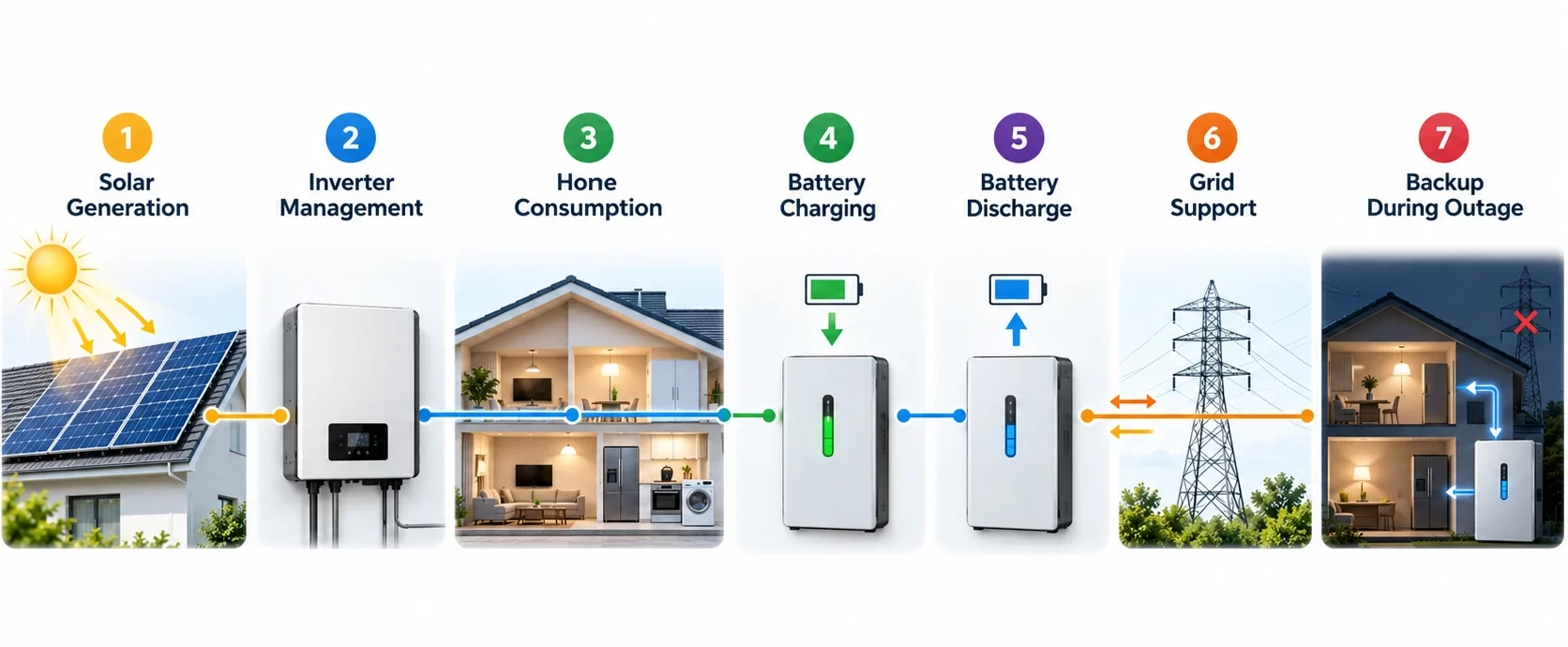
Step 1: Solar panels generate electricity
Solar panels convert sunlight into DC electricity.
The amount of electricity they produce changes throughout the day.
For example, a 5 kW solar array might produce much less than 5 kW early in the morning, reach higher output around the middle of the day, and then fall again in the afternoon.
The rated 5 kW capacity is therefore not the same as producing 5 kW continuously.
Step 2: The hybrid inverter manages the electricity
The solar panels produce DC electricity, while most household appliances use AC electricity.
The hybrid inverter handles the conversion and manages the system’s energy flows.
It considers factors such as:
- Current solar generation
- Household electricity demand
- Battery SOC
- Battery charging and discharging limits
- Grid availability
- System settings
- Backup requirements
This is why the inverter is the central component in a hybrid solar system.
Step 3: Solar power can supply your home
When solar production is available, the system can use that electricity to supply household loads.
For example:
- Solar generation: 4 kW
- Home demand: 2.5 kW
Potential surplus:
4 kW − 2.5 kW = 1.5 kW
That surplus can potentially be sent to the battery or grid, depending on the system configuration.
Step 4: Excess solar can charge the battery
If solar production is higher than your current household demand, the battery can store some of the available energy.
For example:
- Solar generation: 6 kW
- Home demand: 2 kW
- Available surplus: 4 kW
The battery may charge using that surplus, subject to its maximum charging power, state of charge and inverter limitations.
If the battery is already full, the system may export excess electricity to the grid if export is enabled and permitted. Otherwise, solar production may be curtailed.
Step 5: The battery can supply power later
When solar production falls, stored battery energy can be used to supply the home, depending on the inverter’s operating mode and battery settings.
For example:
- Home demand: 3 kW
- Solar generation: 1 kW
There is a potential 2 kW shortfall.
A battery-enabled system may use stored energy to cover some or all of that gap.
The actual amount depends on the battery’s available energy, discharge power and configured operating limits.
Step 6: The grid can cover a shortfall
If solar and available battery power cannot meet household demand, the grid can provide additional electricity when grid-connected operation is available.
For example:
- Home demand: 5 kW
- Solar generation: 2 kW
- Battery supplying: 1 kW
The remaining requirement is:
5 − 2 − 1 = 2 kW
The grid can potentially supply that 2 kW.
This allows the home to continue operating even when solar production is temporarily low.
Step 7: The system can provide backup during a power outage
One of the major differences between a standard grid-connected solar system and a properly configured hybrid system is backup capability.
When the grid fails, a backup-capable hybrid inverter can isolate the appropriate circuits from the utility grid and use the battery and, where supported, solar generation to supply designated backup loads.
For example, your backup circuit might supply:
- Refrigerator
- Lights
- Wi-Fi router
- Fans
- Selected sockets
If these loads require 1.5 kW, the battery can provide the required power within its operating limits.
However, a hybrid system does not automatically mean the entire house will run during an outage. Backup capacity depends on the inverter, battery, wiring, transfer equipment and which circuits were designed for backup.
Hybrid Solar System Working Diagram
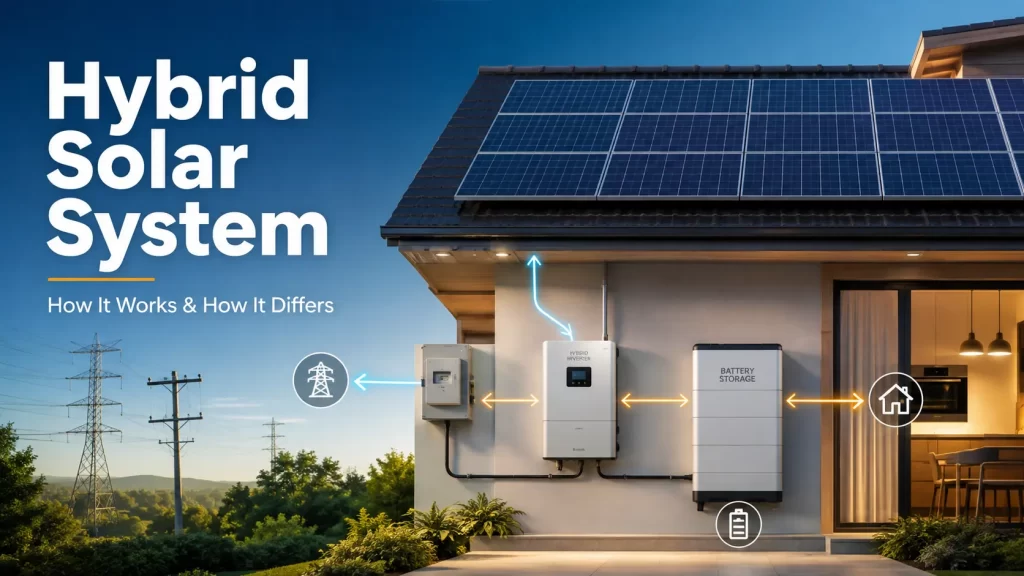
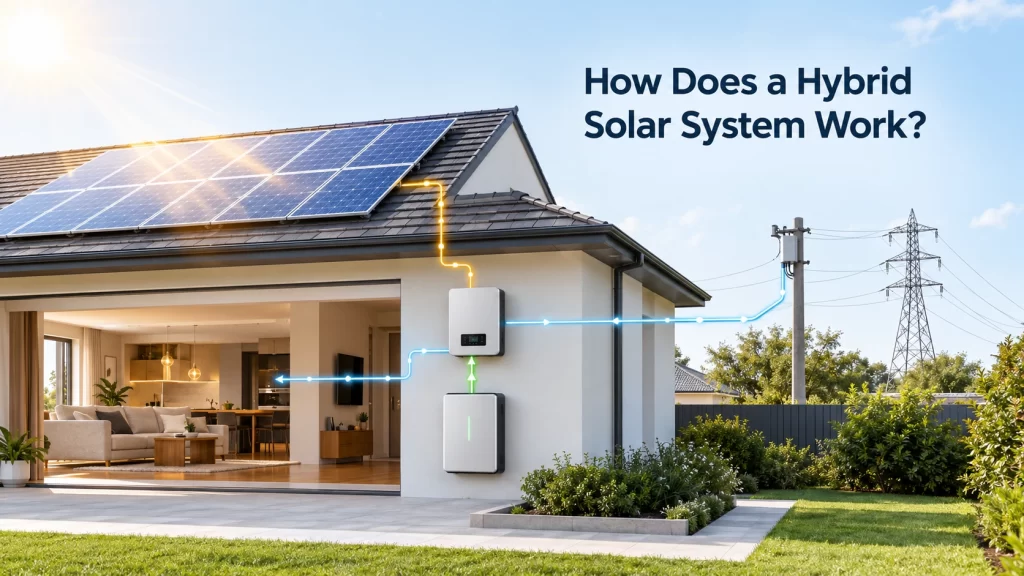
The easiest way to understand the system is to look at the relationship between its main components:
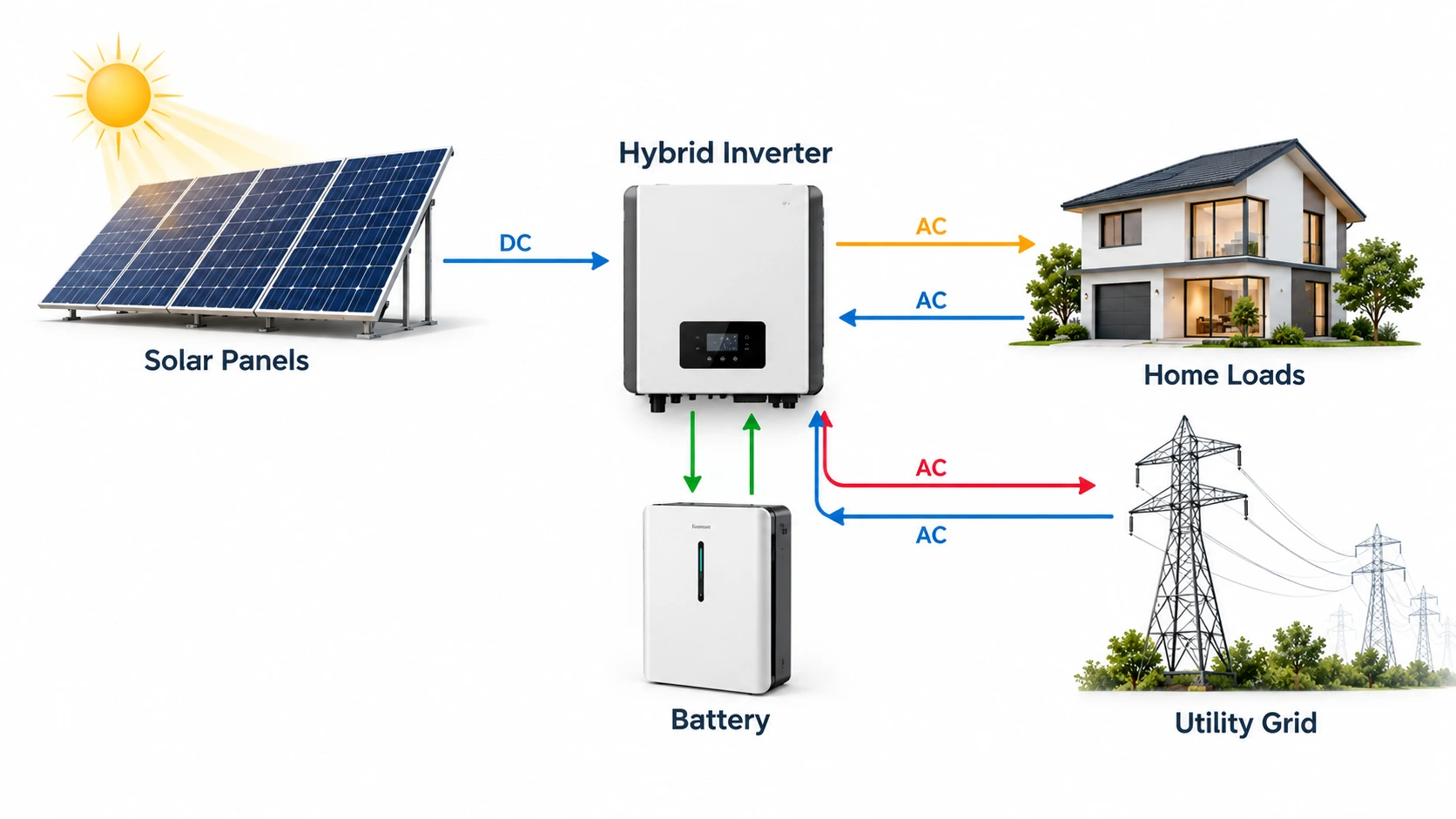
The inverter controls these energy flows according to the system’s configuration.
Solar → Home: Solar energy can supply household appliances.
Solar → Battery: Surplus solar can charge the battery.
Battery → Home: Stored energy can supply loads when required.
Grid → Home: The grid can support the home when available solar and battery power are insufficient.
Solar → Grid: Excess solar may be exported when the system and local regulations allow it.
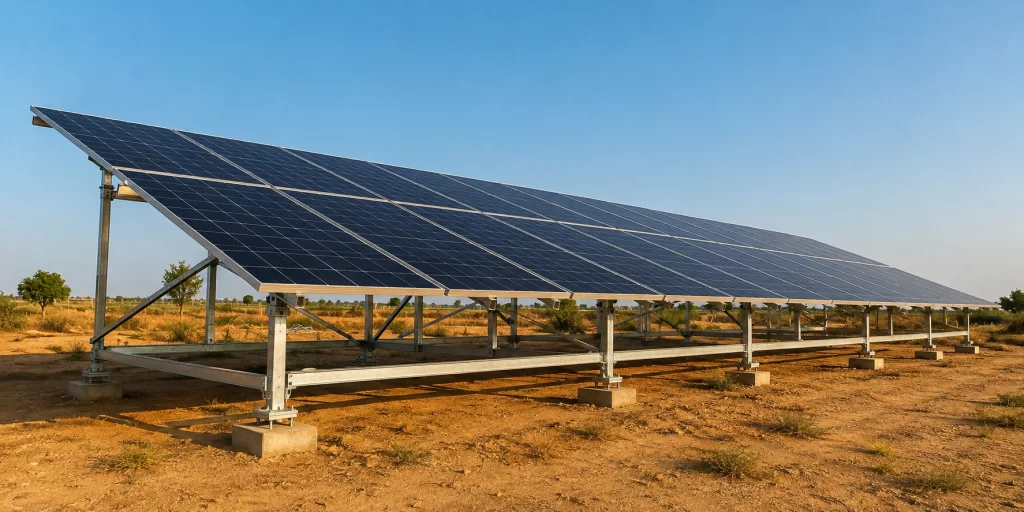
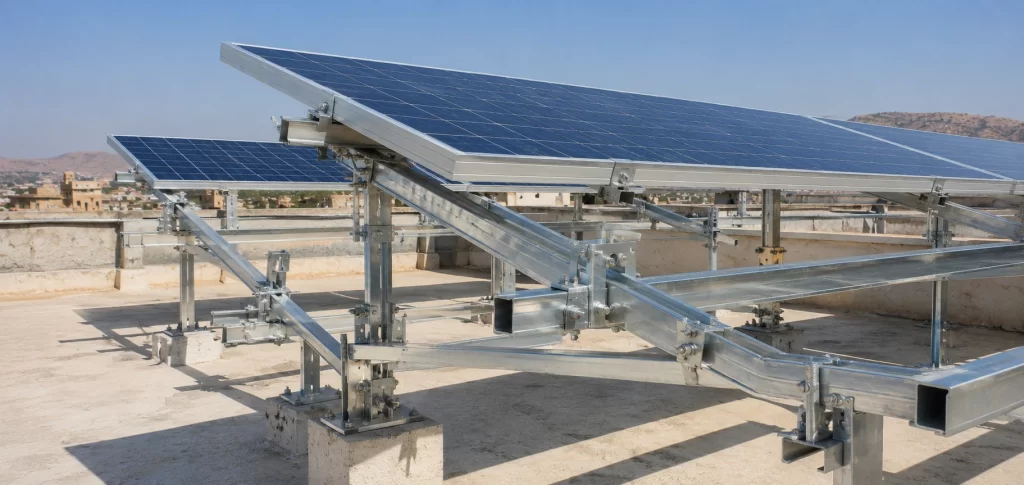
The solar panels are installed on a suitable solar panel structure, which helps maintain their position and withstand environmental loads.
What Happens When Solar Generation Changes?
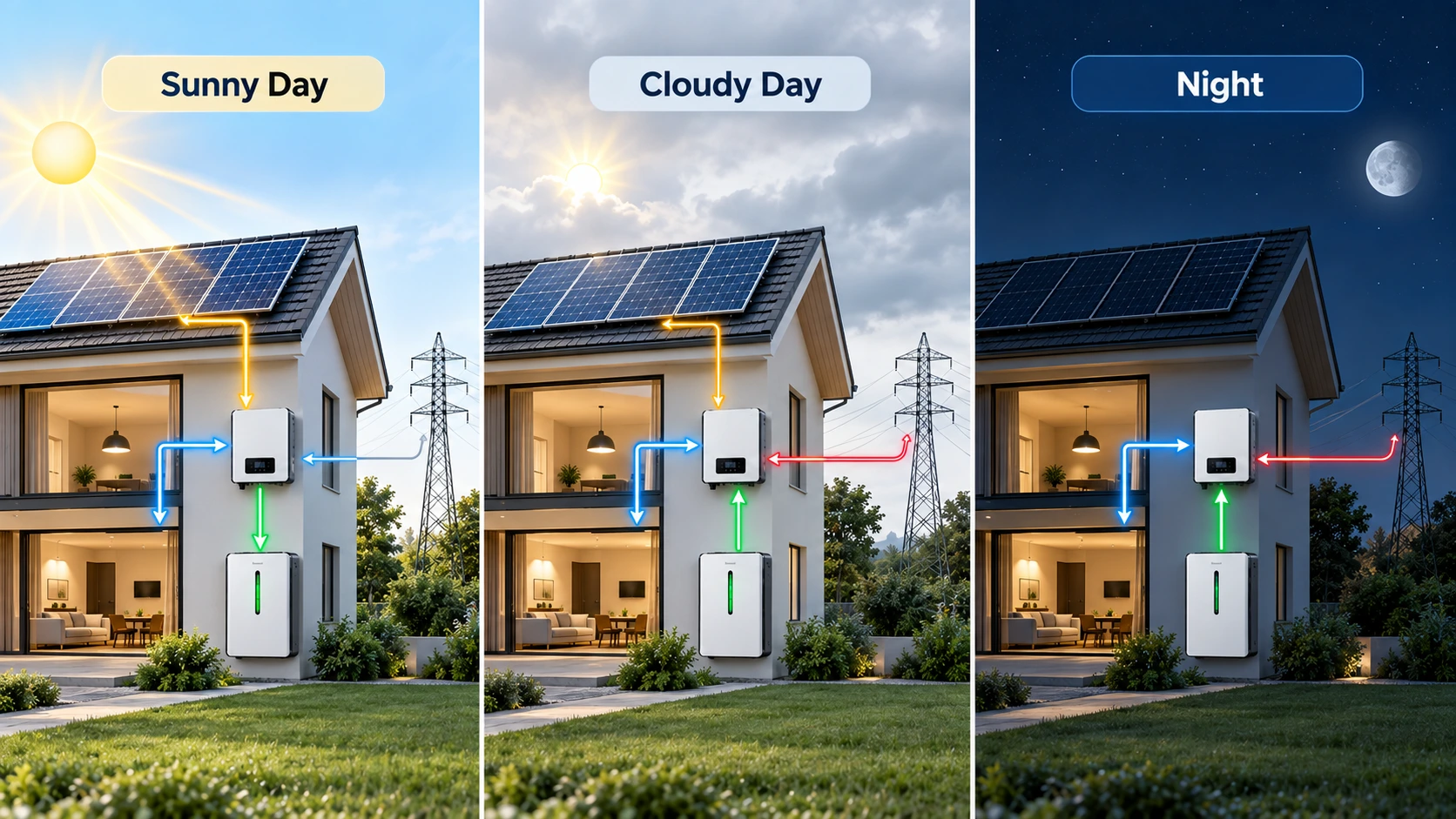
Solar production is not constant. A hybrid system responds differently depending on available sunlight and household demand.
During strong sunlight
Suppose:
- Solar generation = 5 kW
- Home demand = 2 kW
There is approximately 3 kW of available surplus.
That surplus can potentially charge the battery or be exported, depending on the system configuration.
During lower solar production
Later in the day:
- Solar generation = 2 kW
- Home demand = 4 kW
There is a 2 kW shortfall.
The battery and/or grid may cover the difference, depending on the inverter’s settings and available battery energy.
What Happens to a Hybrid Solar System at Night?
At night, the solar panels normally produce little or no useful electricity because there is no sunlight.
The system can therefore use stored battery energy if the battery has sufficient charge and the operating mode allows discharge.
For example:
- Home demand = 1.5 kW
- Solar generation = 0 kW
- Battery = available
The battery can potentially supply the home’s loads.
How long it lasts depends on the battery’s usable capacity, the load and the system’s efficiency.
For example, a battery with 10 kWh of usable energy cannot simply be assumed to run a constant 1.5 kW load for 6.67 hours in real-world conditions because conversion losses and operating limits also matter.
Can a Hybrid Solar System Work on Cloudy Days?
Yes. Solar panels can still generate electricity on cloudy days, but their output is usually lower than under strong direct sunlight.
Suppose your home needs 3 kW but the solar system is producing only 1 kW because of heavy cloud cover.
The remaining 2 kW can potentially come from the battery, grid or a combination of both, depending on the system configuration.
This is one reason battery storage can be useful: it can help cover periods when solar generation drops temporarily.
What Happens When Solar Power Is Not Enough?
A hybrid solar system does not stop working simply because solar generation falls below household demand.
The system can use other available sources.
For example:
| Condition | Example |
| Home demand | 4 kW |
| Solar generation | 2 kW |
| Battery supply | 1 kW |
| Remaining grid supply | 1 kW |
So:
2 kW solar + 1 kW battery + 1 kW grid = 4 kW home demand
The exact combination depends on the inverter’s operating mode and settings.
How Does a Hybrid Solar System Work for a Home?
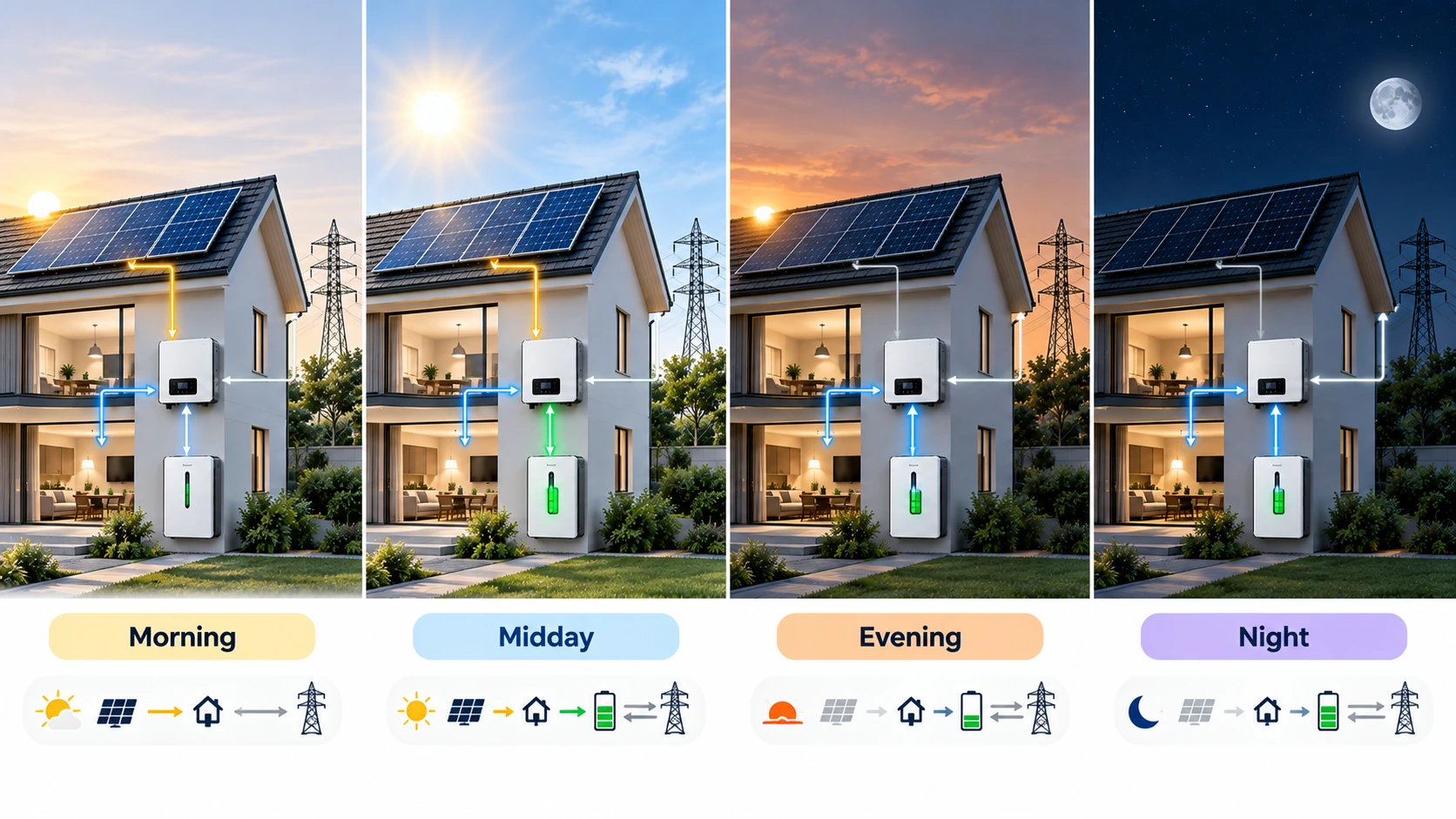
Consider a home with:
- 5 kW solar array
- 5 kW hybrid inverter
- 10 kWh battery
A typical day might look like this:
Morning
Solar production starts increasing as sunlight becomes available.
The home can use available solar power, while the grid or battery may support demand when solar output is insufficient.
Midday
Solar production is generally higher.
If generation exceeds household demand, the battery can charge with available surplus.
Evening
Solar production falls as sunlight decreases.
The battery can potentially supply the home using energy stored earlier in the day.
Night
Solar production is normally unavailable.
The battery can continue supplying loads if enough usable energy remains and the system is configured to discharge at night.
Power outage
If the system has backup capability, the inverter can isolate the backup loads from the grid and supply them using the battery and, where supported, solar generation.
This is the basic way a hybrid solar system can reduce grid dependence while also providing backup power.
Can a Hybrid Solar System Work Without a Battery?
Some hybrid inverters can operate without a battery, but it depends on the specific inverter and system configuration.
Without a battery, the system cannot store excess solar energy for later use.
During periods when solar generation exceeds household demand, excess electricity may be exported to the grid if permitted and configured for export. Otherwise, the inverter may reduce solar production.
When solar production falls, the system may need to use the grid if it is available.
The main benefit you lose without a battery is stored energy for later use and battery-based backup.
kW vs kWh in a Hybrid Solar System
Two numbers often cause confusion when understanding hybrid solar systems: kW and kWh.
kW measures power
kW tells you how much electrical power is being produced, consumed or supplied at a particular moment.
For example:
- Solar output: 4 kW
- Home load: 3 kW
- Inverter capacity: 5 kW
kWh measures energy
kWh tells you how much energy is used or stored over time.
For example:
A 10 kWh battery stores a certain amount of usable electrical energy, subject to its specifications and operating limits.
So:
kW = how much power
kWh = how much energy
This distinction is important when understanding battery operation and backup runtime.
What Determines How a Hybrid Solar System Operates?
The system’s actual behaviour depends on more than just the solar panel capacity.
| Factor | Why it matters |
| Solar generation | Determines how much solar power is available |
| Household demand | Determines how much electricity the home needs |
| Battery SOC | Determines how much stored energy is available |
| Battery power rating | Limits how quickly the battery can charge or discharge |
| Inverter capacity | Limits the power it can manage or supply |
| Operating mode | Determines how the system prioritises available energy |
| Grid availability | Determines whether grid support is available |
| Backup configuration | Determines which loads operate during an outage |
| Export settings | Determines whether surplus power can be sent to the grid |
Because these factors vary between installations, two hybrid solar systems with the same solar capacity can behave differently.
Common Hybrid Solar System Operating Scenarios
| Situation | What can happen |
| Sunny day, low home demand | Solar supplies the home and surplus may charge the battery |
| Sunny day, high home demand | Solar supplies available power and other sources can cover the gap |
| Cloudy weather | Solar still generates power, but output may be reduced |
| Night | Battery and/or grid can supply the home |
| Battery full | Surplus solar may be exported or curtailed |
| Low battery | Grid may support the home when available |
| Power outage | Backup-capable systems can supply selected loads |
The exact behaviour depends on the inverter, battery, configuration and local grid requirements.
FAQs About How a Hybrid Solar System Works
1. How does a hybrid solar system work step by step?
Solar panels generate DC electricity, the hybrid inverter manages the available power, and the home uses electricity as needed. Excess solar can charge the battery, while stored energy can be used later. The grid can support the home when required.
2. What is the working principle of a hybrid solar system?
A hybrid solar system balances solar generation, household demand, battery storage and grid power through a hybrid inverter. The inverter manages these energy flows according to its operating mode and configuration.
3. Can a hybrid solar system work without a battery?
Yes, some hybrid inverters can operate without a battery. However, without battery storage, the system cannot store solar energy for later use or provide battery-based backup.
4. Can a hybrid solar system work on cloudy days?
Yes. Solar panels can still generate electricity under cloudy conditions, although output is generally lower. The battery or grid can help cover any shortfall.
5. Does a hybrid solar system work during a power outage?
A hybrid system with suitable backup functionality can supply designated loads during a grid outage. It does not necessarily provide backup to the entire house.
6. What happens to excess solar energy in a hybrid system?
Excess solar can charge the battery. If the battery is full or charging is limited, the system may export electricity to the grid where permitted or reduce solar production.
Final Takeaway
A hybrid solar system works by combining solar generation, battery storage, an intelligent hybrid inverter and the utility grid.
The basic process is:
Solar panels generate electricity → inverter manages the energy → home uses available power → surplus can charge the battery → stored energy can be used later → grid support is available when needed.
During a power outage, a properly configured backup system can also keep selected loads running without relying on the utility grid.
The important point is that there is no single fixed energy-flow sequence for every hybrid system. The inverter’s model, operating mode, battery, backup setup and grid requirements determine exactly how the system behaves.