Solar buyers usually start with one question: on-grid, off-grid, or hybrid solar system, which one do I actually need?
The difference between on-grid, off-grid and hybrid solar systems comes down to three things: whether the system is connected to the utility grid, whether it stores energy in a battery, and what happens to your home when the grid goes down. Get those three answers right, and the right system picks itself.
This guide breaks down all three types of solar systems, not just what they are, but how they’re priced, maintained, regulated, and which one actually fits your situation.
The Core Difference in One Framework
Before comparing costs and specs, it helps to answer two yes/no questions:
- Is the system connected to the utility grid?
- Does the system have a battery?
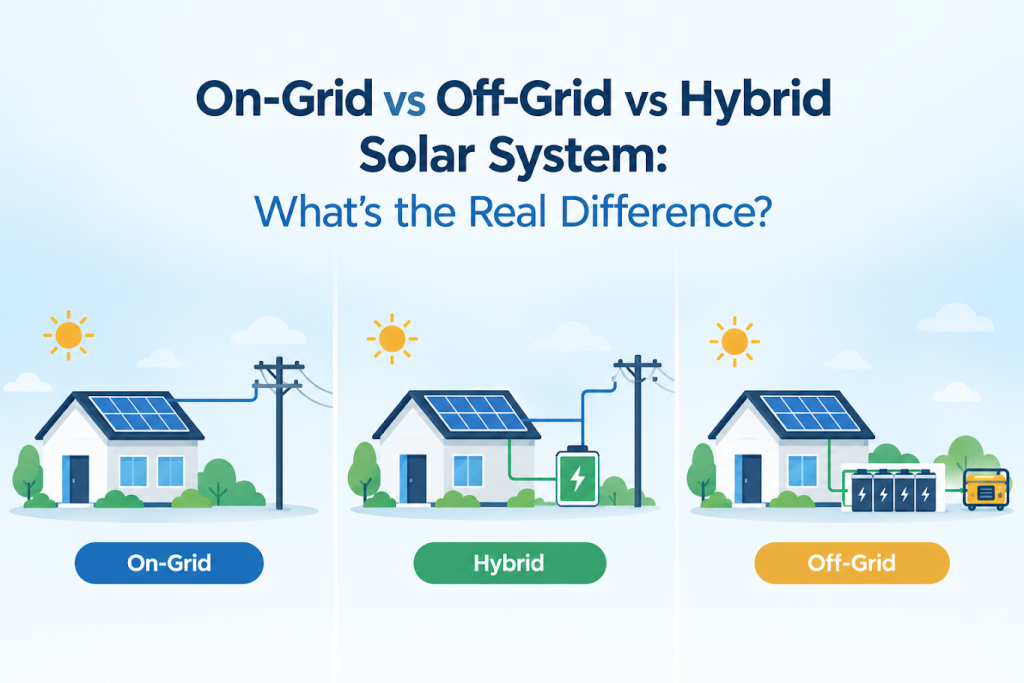
| Grid-connected? | Has a battery? | System type |
| Yes | No | On-grid |
| No | Yes | Off-grid |
| Yes | Yes | Hybrid |
That’s the entire difference between on-grid, off-grid and hybrid solar systems in one table. Everything else, cost, backup ability, complexity, regulation, flows from those two answers. The tables below put that into practice; the sections after explain the reasoning behind each number.
- An on-grid solar power system (also called a grid-tied solar system or solar panel on-grid system) leans entirely on the utility grid for storage. No battery means no backup.
- An off-grid solar system (or solar PV off-grid setup) leans entirely on its own battery. No utility connection means no external backup either, it’s fully self-reliant.
- A hybrid grid solar system keeps both options open: grid when you need it, battery when you don’t.
Quick Comparison Tables
Cost and Payback
| Factor | On-Grid | Hybrid | Off-Grid |
| Relative upfront cost | Lowest | Moderate to High | Highest |
| Payback period | Shortest | Moderate | Longest (or n/a, no bill to offset) |
| Cost per kWh delivered over system life | Lowest | Moderate | Highest |
| Battery required | No | Yes | Yes (larger) |
| Backup generator typically needed | No | No (battery covers backup loads) | Often yes |
Complexity, Backup and Grid Dependence
| Factor | On-Grid | Hybrid | Off-Grid |
| Installation complexity | Lowest | Moderate | Highest |
| Backup during an outage | None | Selected critical loads | Full home (by design) |
| Grid dependence | High | Low to moderate | None |
| Works during a power cut | No (shuts off automatically) | Yes, on battery | Yes, always (no grid to lose) |
| Requires utility approval | Yes | Yes | Usually no |
Exact figures vary heavily by region, incentive programs, and local installer pricing, treating these as relative positioning, not fixed numbers.
On-Grid Solar System
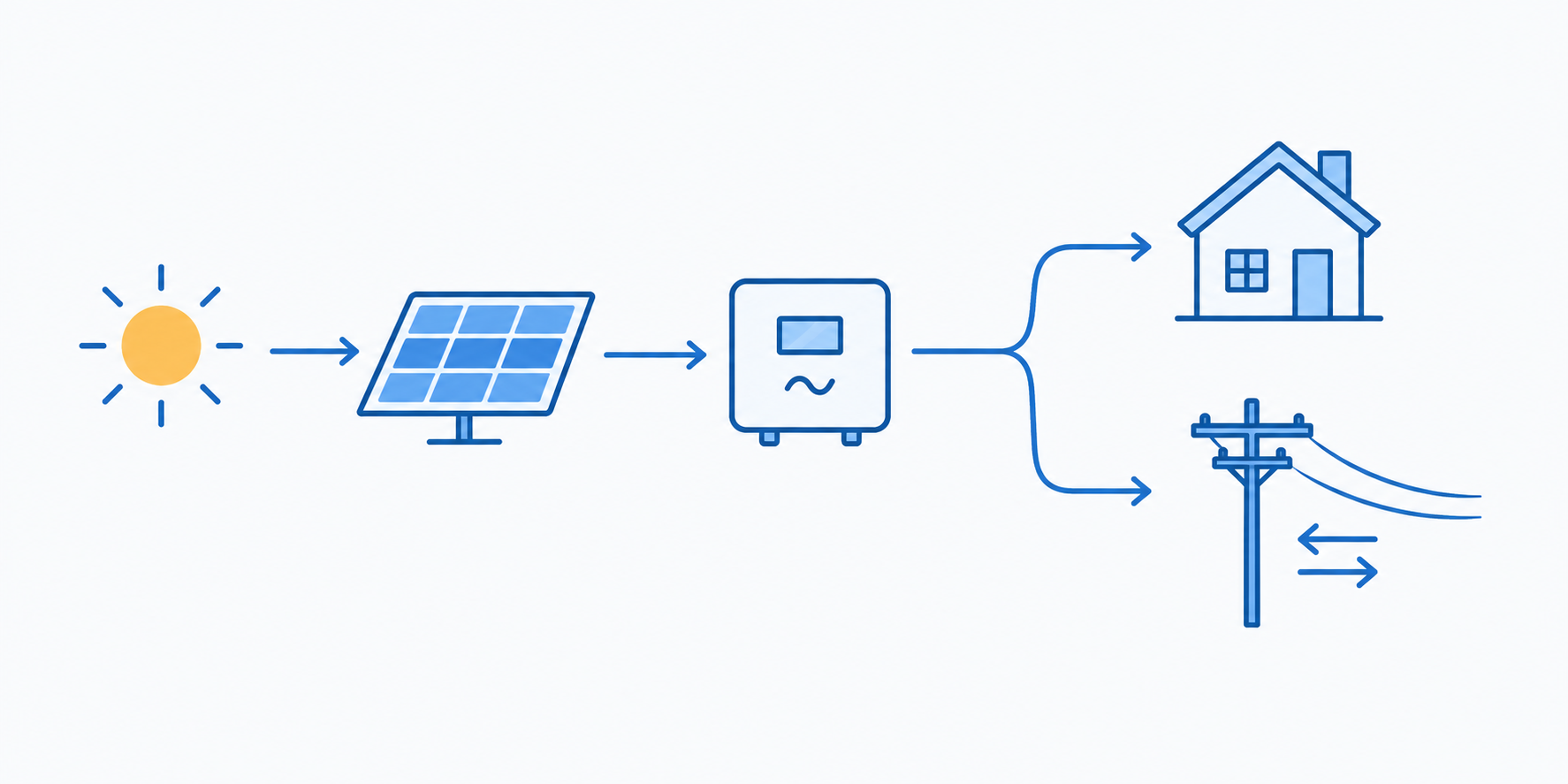
An on-grid system (grid-tied) connects your solar panels directly to the utility grid through a grid-tied solar system inverter. There’s no battery in the loop, solar power either gets used immediately in your home or flows out to the grid.
Most on-grid solar power systems run on net metering: surplus solar flows out through your utility meter as an export credit, and any shortfall is drawn back from the grid as normal. At billing time, the utility nets your imports against your exports, so you’re only charged for the difference. This is why on-grid systems don’t need a battery to be worthwhile, the grid effectively acts as your storage.
The trade-off:
on-grid solar systems shut off completely during a power cut, even in daylight with panels producing full output. This is a safety requirement called anti-islanding protection. Utility linemen may be working on the grid during an outage, assuming it’s dead.
If your inverter kept feeding power into the grid during that outage, it could energize a line workers believe is safe. So grid-tied inverters detect a grid outage and shut down automatically, regardless of how much sun you have.
An on-grid system fits best when grid power is reliable and the main goal is cutting bills, not backup, see the tables above for where it lands on cost and payback.
Off-Grid Solar System
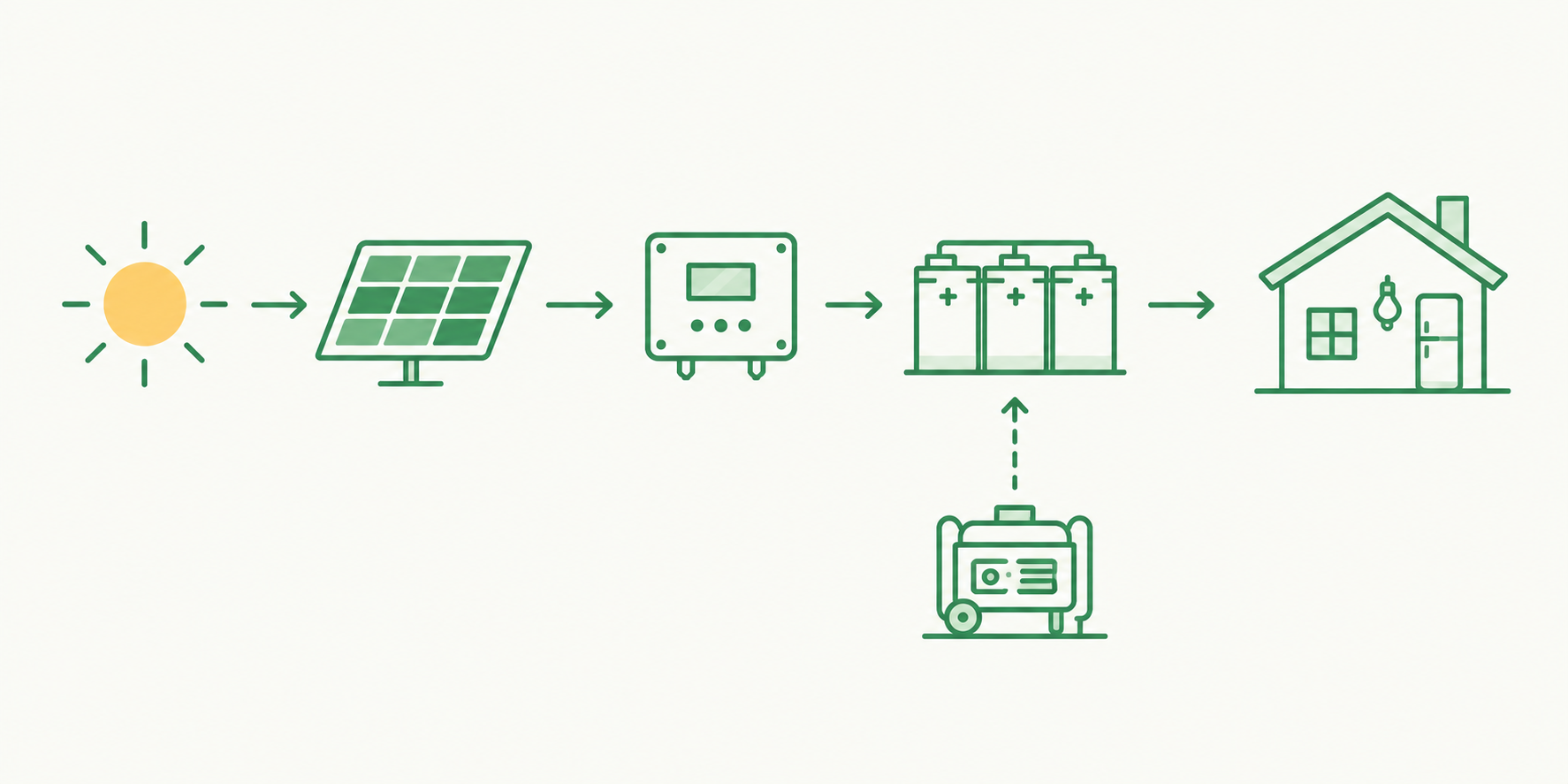
An off-grid solar system has no utility connection at all. All power comes from solar panels and a battery bank, there’s no fallback source if both fall short.
This changes the sizing math. A hybrid or on-grid system can lean on the grid whenever solar and battery fall short. An off-grid solar power system can’t, it has to be sized to cover 100% of your demand, including several days of low-sun buffer.
Where a hybrid system’s battery might be sized just for a few hours of backup on critical loads, an off-grid solar energy system’s battery has to cover your household’s entire daily consumption, plus a margin for cloudy stretches.
Because there’s no utility fallback, most real-world off-grid solar power systems for homes pair the battery with a backup generator (diesel, petrol, or propane). When solar output and battery charge both run low during an extended low-sun period, the generator recharges the battery and covers loads, filling the same gap role the utility grid plays in a hybrid system.
Off-grid solar fits best when the property has no grid access at all, or when full energy independence matters more than upfront cost, see the tables above for how that trade-off plays out in price and complexity.
Hybrid Solar System
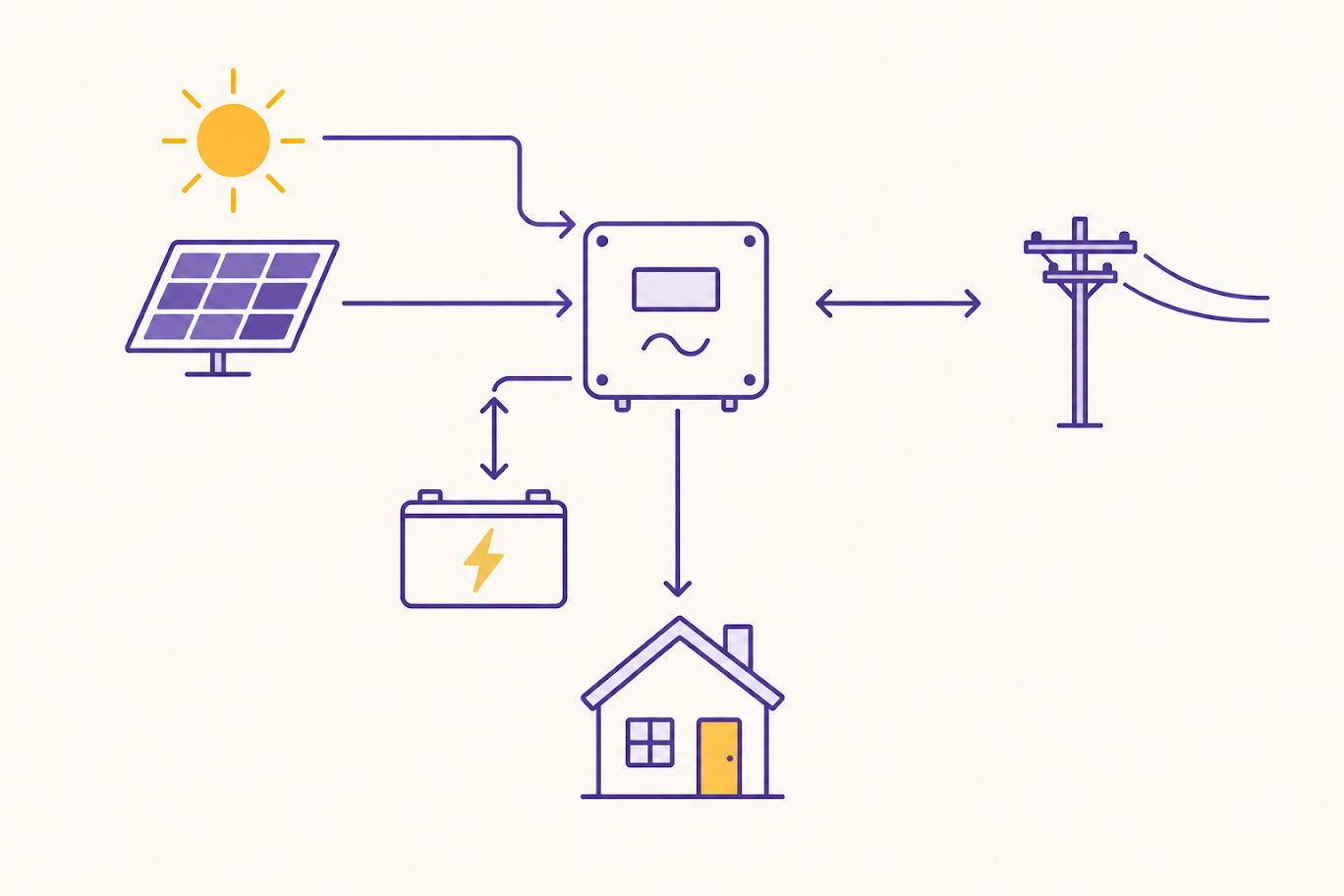
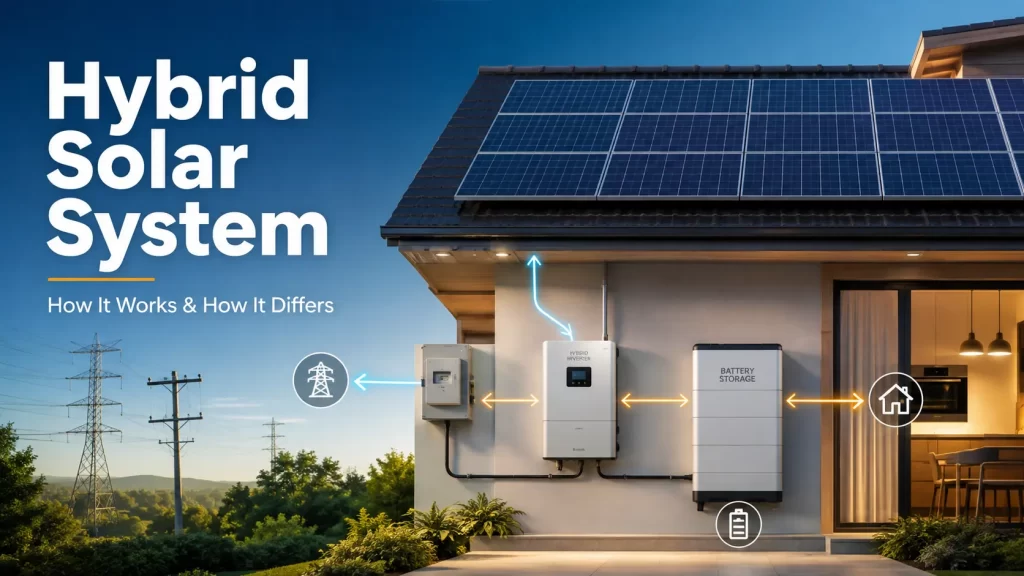
A hybrid solar system combines both approaches: grid-tied like an on-grid system, but with a battery like an off-grid system. That’s what a hybrid on-grid inverter (sometimes called an on-grid hybrid solar inverter) is built to manage, switching between solar, battery, and grid depending on conditions.
The short version for this article: hybrid sits in the middle on cost, complexity, and backup capability, cheaper than off-grid, more capable than on-grid, but not the default answer for everyone.
Maintenance and Lifespan Comparison
- On-grid systems have the least to maintain, no battery to monitor or replace, just panels and a grid-tie inverter. Grid-tie inverters commonly last 10 to 15 years before replacement.
- Hybrid systems add battery maintenance to the mix. Lithium batteries (the common choice in new hybrid installs) need little upkeep but do degrade gradually with charge cycles, see the lithium-vs-lead-acid comparison in our Hybrid Solar System Components guide for cycle life and usable-capacity differences.
- Off-grid systems carry the most maintenance load: a larger battery bank cycling daily, plus generator servicing if one is installed. Off-grid batteries typically see harder daily use than a hybrid system’s backup-only battery, which can mean earlier replacement.
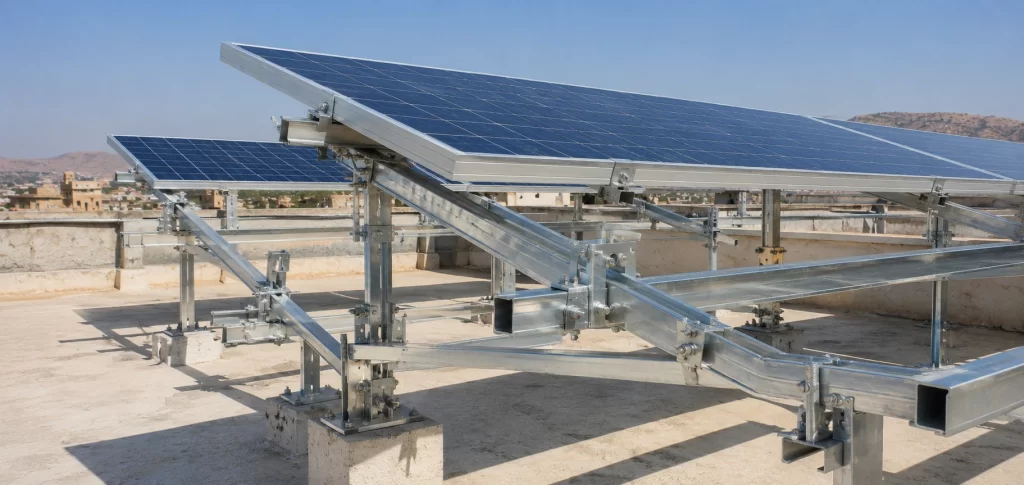
Across all three, mounting hardware and wiring have the same baseline maintenance needs, see our Mounting Structure Design Guide for what proper installation looks like regardless of system type.
Regulatory and Utility Considerations
- On-grid and hybrid systems both typically require utility approval before connection: net metering agreements, inspection, and sometimes a meter swap. Export limits and compensation rates vary by utility and region.
- Off-grid systems, having no grid connection, usually skip utility approval steps entirely, though local building and electrical codes still apply.
- Export and net-metering policy is the biggest regulatory difference between on-grid solar systems and off-grid solar energy setups: one earns bill credits for surplus power, the other has nowhere to send it.
- Government solar incentive programs often apply differently by system type, some subsidize grid-tied installations specifically, others include hybrid and off-grid equally. Check your local program’s eligibility rules before assuming a subsidy applies equally.
Environmental and Sustainability Angle
- On-grid systems reduce fossil-fuel grid draw but stay fully dependent on the grid’s mix during outages and low-sun periods, since there’s no battery to bridge the gap.
- Hybrid and off-grid systems cut grid dependence further, but batteries carry their own manufacturing and end-of-life disposal footprint. Larger battery banks (as in off-grid) mean a bigger share of the system’s total environmental cost sits in the battery, not the panels.
- Off-grid systems with generator backup partly offset their independence gains with fuel consumption during low-sun stretches, worth factoring in if minimizing carbon footprint, not just grid independence, is the goal.
Decision Framework by Use Case
| Your situation | Likely best fit |
| Reliable grid, no outage concerns, budget-focused | On-grid |
| Reliable grid but occasional outages you want covered | Hybrid |
| Frequent or long outages, want most loads protected | Hybrid (sized with a larger battery) |
| No utility grid access at all | Off-grid |
| Want to sell surplus power back to the utility | On-grid or hybrid (not off-grid) |
| Full energy independence is the priority, cost secondary | Off-grid |
For hybrid sizing specifics once you’ve landed on that answer, our Hybrid Solar System Guide walks through battery and inverter sizing based on your backup load.
Common Myths Debunked
“Off-grid is always the greenest option.”
Not necessarily, larger battery banks and generator fuel use can offset some of the independence gains. A grid-tied system drawing from a clean grid mix can have a lower footprint than an off-grid system relying on a diesel generator during cloudy stretches.
“Hybrid is always better than on-grid.”
Only if backup power or storage is something you actually need. If your grid is reliable and you just want lower bills, the extra cost of a battery in a hybrid system may not pay for itself.
“Any hybrid system gives you a whole-house backup.”
Backup capacity depends entirely on how the system is sized and wired, most hybrid installs back up select critical circuits, not the entire home, unless specifically designed and sized for that.
FAQs
Can you convert an on-grid system to hybrid later?
Often yes, if the existing inverter supports battery addition or can be swapped for a hybrid-capable one. It depends on the original inverter model and panel configuration, not every on-grid setup is upgrade-ready without additional work.
Is off-grid solar legal if grid access is available?
Generally yes, though some jurisdictions have specific codes around fully disconnecting a property from utility infrastructure. Check local regulations before planning a full off-grid setup in an area with existing grid access.
Which system type has the fastest ROI?
On-grid typically has the shortest payback period, since it has the lowest upfront cost and benefits from net metering credits without the added expense of a battery.
Do all three system types need the same permits?
No. On-grid and hybrid systems usually require utility interconnection approval; off-grid systems typically skip that step but still need to meet local electrical and building codes.
Wrap-Up
The difference between on-grid, off-grid and hybrid solar systems isn’t really about which is “best,” it’s about which two questions matter most to you: do you have (or want) a grid connection, and do you need a battery. Answer those, and the right system type, and the right next guide to read, follows naturally.