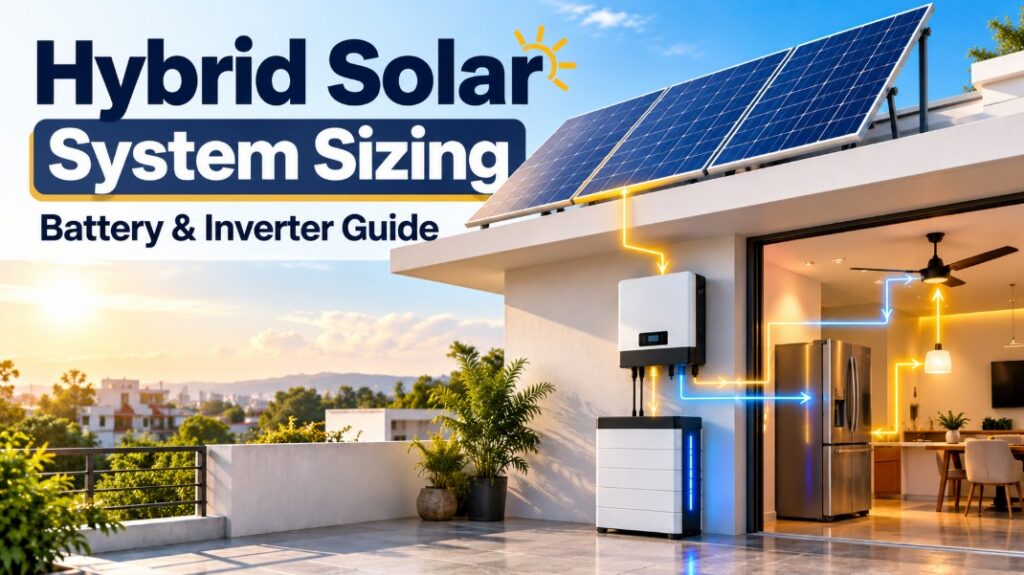
Quick answer: Sizing a hybrid solar system means working out two things together: how much energy your battery needs to store (in kWh) and how much power your inverter needs to deliver (in kW). Get your daily load, your backup hours and your biggest appliance’s starting power, and the rest of the sizing follows from there.
Why battery and inverter sizing go together
Here’s where most people get confused. Battery capacity is energy, measured in kWh. Inverter rating is power, measured in kW. These aren’t the same thing, and mixing them up leads to real problems.
A battery can hold plenty of energy and still fail to start your fridge. So a big battery alone doesn’t guarantee a working system. The inverter has to handle the instant power your appliances demand, not just the total energy stored. If you’re still getting familiar with the basics, our guide on how a hybrid solar system works is a good place to start. That’s why you size both together, not one after the other.
How to size your battery
Start with a load audit. List what you want to run during an outage: lights, a fridge, a few fans, maybe a router. Add up the total watts, then convert to kWh based on how many hours a day you’ll run them.
Next, decide your autonomy, which is how many hours or days you want the battery to last without sunlight. A typical Indian household backing up essential loads during a power cut usually plans for 4 to 8 hours.
Then factor in depth of discharge, or DoD. This is the percentage of battery capacity you can safely use. Lithium batteries handle 80 to 90% DoD, while lead-acid batteries only handle around 50%. So a lead-acid battery needs roughly double the nameplate capacity to deliver the same usable energy as lithium. Our components guide covers how your battery works alongside the rest of the system, if you’d like the fuller picture.
Finally, account for round-trip efficiency, usually around 85 to 90%, since some energy is lost during charging and discharging.
The formula:
Battery capacity (kWh) = Daily load (kWh) × Autonomy days ÷ (DoD × Efficiency)
Worked example: Say your essential loads total 3 kWh per day, and you want 1 day of backup using a lithium battery (90% DoD, 90% efficiency).
3 × 1 ÷ (0.9 × 0.9) = 3.7 kWh nominal battery capacity
So you’d look for a battery rated around 4 kWh to cover this comfortably.
A quick note on battery chemistry
Lithium and lead-acid batteries behave differently, and this changes your sizing math. Lithium costs more upfront but needs less nameplate capacity, lasts longer, and handles a higher DoD. Lead-acid is cheaper initially but needs more capacity for the same usable energy, since you can only draw down about half of it safely. Most new hybrid installations in India now use lithium for this reason.
How to size your inverter
Your inverter needs to cover two things: continuous load and surge load.
Continuous load is the total power your appliances draw while running normally. Add up the wattage of everything you’ll run at the same time, lights, fans, a TV, a fridge.
Surge load is different. It’s the extra power needed for a split second when a motor or compressor starts up, think of your fridge, water pump or air conditioner kicking in. According to Battle Born Batteries’ sizing guide, this starting surge is commonly around twice the appliance’s normal running wattage, though it can run higher for larger motors.
Worked example: Using the same household from before, say your continuous load is 1,200 watts. Your fridge alone needs a startup surge of around 2,400 watts.
Your inverter’s continuous rating should comfortably cover 1,200 watts, and its surge rating needs to handle at least 2,400 watts. If the inverter can’t manage that surge, it’ll shut down or simply fail to start the fridge, even though it handles the running load just fine.
Most installers also add a safety margin of around 25% on top of the calculated continuous load, so in this example, you’d look for an inverter rated closer to 1,500 watts continuous.
Inverter size chart
Here’s a quick reference based on typical home sizes:
| Home profile | Continuous load | Recommended inverter size | Suggested battery voltage |
|---|---|---|---|
| Small home (lights, fans, TV) | 800 to 1,200 W | 1.5 kW | 12V or 24V |
| Medium home (adds fridge, water pump) | 1,500 to 2,500 W | 3 kW | 24V or 48V |
| Larger home (adds AC, more appliances) | 3,000 to 5,000 W | 5 kW | 48V |
Use this as a starting point, then check your own load audit against it to confirm the fit. If you’re also weighing whether a hybrid system suits your home at all, our on-grid vs off-grid vs hybrid comparison breaks down how each setup handles backup differently.
Sizing checklist
Before you finalise anything, run through this list:
- List every appliance you want backed up, with its running wattage
- Decide your autonomy hours or days
- Check your battery’s DoD and efficiency rating
- Calculate nominal battery capacity using the formula above
- List your biggest surge loads, usually motors and compressors
- Add a 25% safety margin to your continuous load
- Match your inverter’s surge rating to your highest startup load
- Confirm your battery voltage matches what your inverter supports
FAQ
What inverter capacity do I need for my home?
It depends on your continuous load. A small home with basic lighting and fans usually needs around 1.5 kW, while a larger home running an AC and multiple appliances typically needs 5 kW or more. Always check surge requirements too, not just continuous load.
How much battery capacity do I need for a hybrid solar system?
Multiply your daily essential load in kWh by your desired autonomy days, then divide by your battery’s DoD and efficiency. Most Indian households planning for a day of backup land somewhere between 3 and 6 kWh.
Does a bigger battery mean I don’t need a bigger inverter?
No. Battery capacity is energy, and inverter rating is power. A large battery can still fail to start a high-surge appliance if the inverter itself isn’t rated for that surge.
What’s the difference between continuous load and surge load?
Continuous load is what your appliances draw while running normally. Surge load is the short burst of extra power needed when a motor or compressor starts, which can run around twice the normal wattage or higher for larger motors.
Should I choose lithium or lead-acid for my hybrid battery?
Lithium costs more upfront but needs less capacity for the same backup, lasts longer, and handles a higher DoD. Lead-acid is cheaper initially but needs roughly double the capacity to deliver the same usable energy.